
Dry eye is often treated as an eye problem alone, but the eye is connected to the rest of the body. Autoimmune disease, thyroid disorders, diabetes, skin conditions and dozens of everyday medications can reduce tear production, thin the oil layer of the tear film, or keep the lids from closing. At the Dry Eye Center at Eye MDs of Inland in Upland, finding that cause comes first.
Never stop or change a prescribed medication because of dry eye without talking to the prescribing doctor first. The Dry Eye Center coordinates with your prescriber and treats the eye.
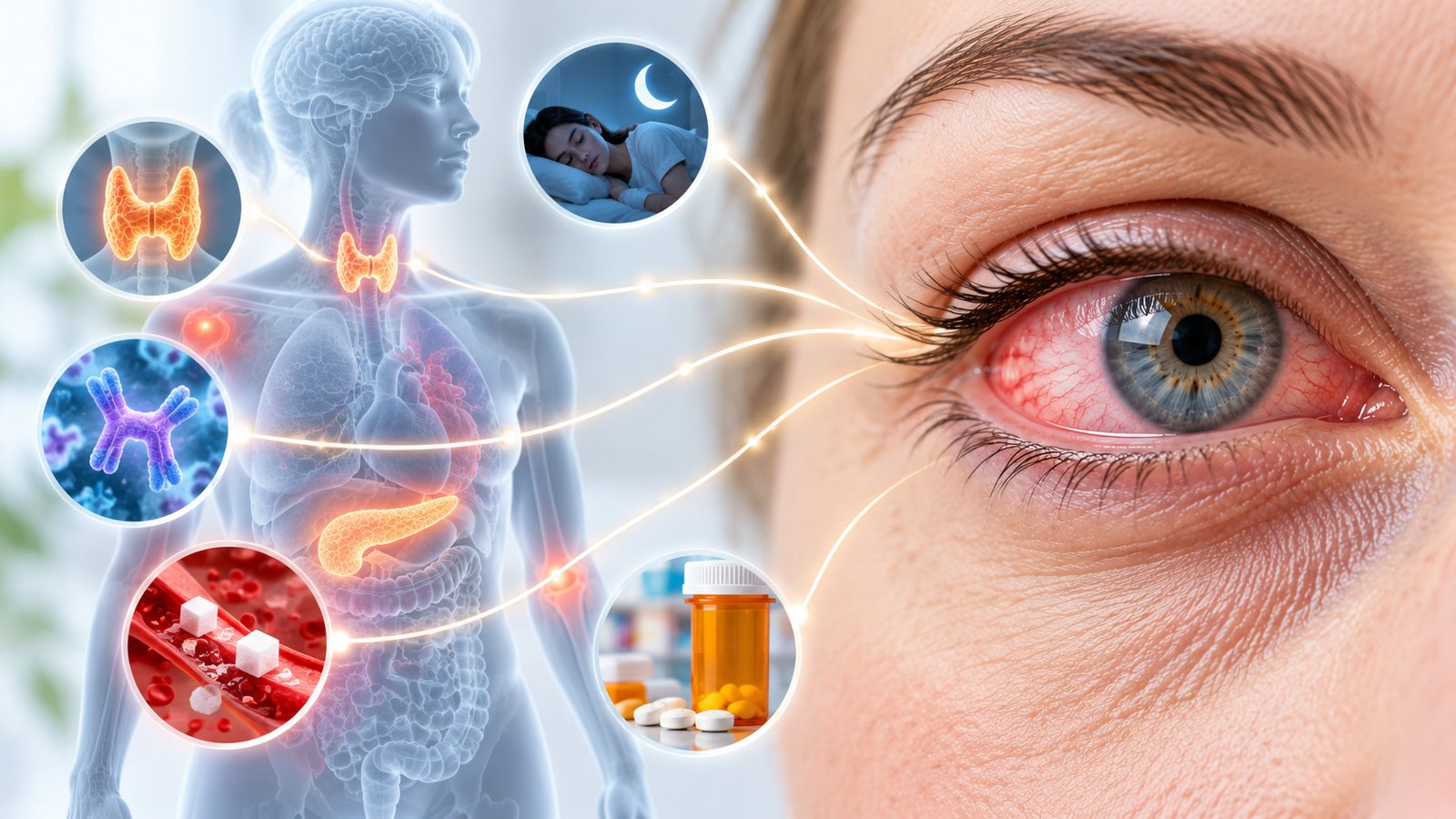
Part 1: Diseases that cause dry eye
The TFOS DEWS II Epidemiology Report rates Sjogren’s syndrome and connective tissue disease as consistent risk factors, and diabetes, rosacea and thyroid disease as probable ones.
Autoimmune and rheumatologic disease
In Sjogren’s syndrome the immune system attacks the tear and saliva glands, so tear volume falls (aqueous-deficient dry eye) and the mouth is dry too. The Sjogren’s Foundation counts as many as four million Americans, 90 percent women. It is primary when alone and secondary with another autoimmune disease:
- Rheumatoid arthritis: the most common partner of secondary Sjogren’s.
- Lupus: about 30 percent of people with Sjogren’s also have lupus.
- Scleroderma: fibrosis stiffens the lids and glands.
- Graft-versus-host disease: after a stem cell transplant, donor immune cells scar the tear and oil glands.
What we do: blood work referral, rheumatology co-management, punctal plugs or Lacrifill canalicular gel, anti-inflammatory drops and serum tears. See our Sjogren’s syndrome page.
Thyroid disease
Graves’ disease can cause thyroid eye disease; the American Thyroid Association reports that about one in three people with Graves’ disease develops eye symptoms. Swollen orbital tissue pushes the eye forward and retracts the lids, so more cornea is exposed and the lids may not close in sleep. Hypothyroidism is a milder contributor. What we do: lubrication, nighttime gel or taping, and eyelid procedures for exposure drops cannot control.
Diabetes
High blood sugar damages the fine corneal nerves that signal the lacrimal gland to make tears, so production drops and the cornea heals slowly. What we do: staining and Schirmer testing at every visit, serum tears for neurotrophic disease.
Rosacea and ocular rosacea
Rosacea inflames the eyelid margin and the meibomian (oil) glands, producing meibomian gland dysfunction (MGD), the evaporative type of dry eye. Red lid margins and recurring styes are the clues. What we do: meibography, LipiFlow thermal pulsation to clear blocked glands, and lid hygiene.
Skin and allergic disease
Atopic dermatitis and seborrheic dermatitis drive chronic lid inflammation and blepharitis, and allergic conjunctivitis is a probable risk factor in DEWS II. What we do: lid-margin care as on our blepharitis page, short-course anti-inflammatory drops, and allergy control without drying oral antihistamines.
Neurologic disease
- Parkinson’s disease: the blink rate falls, so the tear film evaporates.
- Bell’s palsy and lagophthalmos: a weak facial nerve leaves the lid unable to close, so the lower cornea dries.
- Stroke: can reduce blinking and lid tone on one side.
What we do: closure assessment, nighttime taping, and lid tightening for persistent lagophthalmos.
Hormonal changes
Androgens support both the tear and oil glands, and DEWS II lists androgen deficiency as a consistent risk factor. Menopause alone is rated inconclusive, yet dry eye clearly becomes more common in women after 50. What we do: treat the gland problem we find.
Vitamin A deficiency and bariatric surgery
Vitamin A keeps the surface cells of the cornea and conjunctiva healthy. Deficiency is rare in the United States but can follow gastric bypass or other malabsorptive surgery, causing night blindness and severe dryness. We refer for vitamin levels when the history fits.
Sleep apnea and CPAP
Floppy eyelid syndrome, in which a loose upper lid flips open against the pillow, is strongly tied to sleep apnea; AAO EyeWiki notes that up to 96 percent of patients with the syndrome have it. CPAP masks that leak air across the eyes add nightly drying. What we do: lid laxity testing, sleep study referral, and lid tightening surgery.
Hepatitis C, HIV and sarcoidosis
DEWS II lists viral infection, including hepatitis C, as a probable risk factor; hepatitis C and HIV can both produce Sjogren’s-like gland inflammation. Sarcoidosis can infiltrate the lacrimal gland, though the evidence is rated inconclusive. What we do: coordinate with your specialist.
Part 2: Medications that cause dry eye
The TFOS DEWS II Iatrogenic Report names analgesic, anticholinergic, antidepressant, antihistamine, antihypertensive, antineoplastic, anxiolytic, hypnotic, hormonal and sedative drugs. Most block the nerve signals that drive tear secretion or alter the oil glands. Brands are in parentheses.
Antihistamines and decongestants
Diphenhydramine (Benadryl), cetirizine (Zyrtec), loratadine (Claritin) and pseudoephedrine (Sudafed). A consistent risk factor in DEWS II; in the DREAM study antihistamine users had shorter tear break-up time (TBUT) and worse symptoms.
Antidepressants and anxiolytics
- Tricyclics: amitriptyline (Elavil), nortriptyline (Pamelor). Strongly anticholinergic.
- SSRIs: sertraline (Zoloft), fluoxetine (Prozac), escitalopram (Lexapro).
- Benzodiazepines: alprazolam (Xanax), lorazepam (Ativan), diazepam (Valium).
Blood pressure drugs
Diuretics such as hydrochlorothiazide (Microzide) and furosemide (Lasix) reduce fluid throughout the body, and beta blockers such as metoprolol (Lopressor) and atenolol (Tenormin) lower tear secretion. Both are probable risk factors in DEWS II.
Hormone therapy and oral contraceptives
Estrogen replacement therapy (Premarin, Estrace) is a consistent risk factor in DEWS II; oral contraceptives are rated inconclusive.
Isotretinoin and other acne drugs
Isotretinoin (formerly Accutane; Absorica, Claravis) shrinks the meibomian glands and can cause lasting MGD, so we image the glands before and after a course. Spironolactone (Aldactone), used for acne, has anti-androgen effects on the same glands.
Anticholinergics
Overactive bladder drugs such as oxybutynin (Ditropan) and tolterodine (Detrol), and Parkinson’s drugs such as benztropine (Cogentin), block the nerve signal that drives tear secretion.
Chemotherapy and targeted therapy
- 5-fluorouracil: surface irritation and tear duct scarring.
- Taxanes: docetaxel (Taxotere), paclitaxel (Taxol); surface toxicity and tear duct narrowing.
- EGFR inhibitors: erlotinib (Tarceva), osimertinib (Tagrisso); blepharitis, abnormal lashes and dry eye.
- Immune checkpoint inhibitors: pembrolizumab (Keytruda), nivolumab (Opdivo), ipilimumab (Yervoy). A 2026 meta-analysis found dry eye in about 2 percent of patients, sometimes as a Sjogren’s-like syndrome.
GLP-1 drugs
Semaglutide (Ozempic, Wegovy) and tirzepatide (Mounjaro, Zepbound) are not established causes of dry eye. A 2026 review found the human evidence limited and largely observational, and small diabetes studies actually showed better Schirmer and TBUT values in users. We look for another cause first.
Antipsychotics, sleep aids and long-term aspirin
Antipsychotics such as quetiapine (Seroquel) and olanzapine (Zyprexa), and sleep aids such as zolpidem (Ambien) and over-the-counter doxylamine (Unisom), are anticholinergic or sedating and reduce tearing. The evidence for aspirin and NSAIDs is weaker: the DREAM study found shorter TBUT in aspirin users but no significant link for NSAIDs such as ibuprofen (Advil).
How we evaluate a systemic cause
Every patient at the Dry Eye Center starts with a comprehensive dry eye evaluation:
- Symptom questionnaire (SPEED or OSDI style)
- Schirmer test of tear production
- Fluorescein and lissamine green staining, plus TBUT
- Meibography imaging of the oil glands
- Eyelid position, blink and closure check
- Line-by-line medication review
- Blood work referral for suspected Sjogren’s (SS-A/Ro, SS-B/La, ANA, RF) with rheumatology co-management
Treatment is then matched to the cause: plugs or Lacrifill and serum tears for low tear volume, LipiFlow for gland disease, eyelid surgery for closure problems. When a medication is the likely trigger, we send our findings to your prescribing doctor. Learn more at the Dry Eye Center.
Never stop or change a prescribed medication because of dry eye without talking to the prescribing doctor first. The Dry Eye Center coordinates with your prescriber and treats the eye.
Works Cited
1. Stapleton F, et al. TFOS DEWS II Epidemiology Report. The Ocular Surface 2017;15(3):334-365.
2. Gomes JAP, et al. TFOS DEWS II Iatrogenic Report. The Ocular Surface 2017;15(3):511-538.
3. Sjögren’s Foundation. Sjögren’s Disease Fast Facts. Accessed September 2026.
4. American Thyroid Association. Thyroid Eye Disease. Patient information page, accessed September 2026.
5. American Academy of Ophthalmology EyeWiki. Ophthalmologic Manifestations of Obstructive Sleep Apnea. Accessed September 2026.
6. Guo M, et al. Association between systemic medication use and severity of dry eye signs and symptoms in the DREAM study. The Ocular Surface 2024;32:112-119.
7. Chen KY, et al. Incidence and clinical significance of dry eye disease in patients treated with immune checkpoint inhibitors: systematic review and meta-analysis. Acta Ophthalmologica 2026;104(6):e599-e614.
8. Syed S, Bair D, Orlick D. GLP-1 Receptor Agonists and the Ocular Surface: A Narrative Review. Ophthalmology and Therapy 2026.