
Dry Eye Treatments That Match the Cause
Artificial tears are where most people start and where too many people stop. These are the treatments we use when the evaluation shows what is really wrong.
Medically reviewed by Marc Shomer, MD, PhD
Treatment starts with the cause
At the Dry Eye Center, treatment is never chosen from a menu. Your dry eye evaluation tells us whether you make too few tears, whether they evaporate too fast, or whether your eyelids cannot hold them. This page covers the options for underproduction and the anti-inflammatory treatments that help every type. Evaporative dry eye is treated with LipiFlow and lid care, Demodex with Xdemvy, and eyelid position problems with surgery.
Punctal plugs
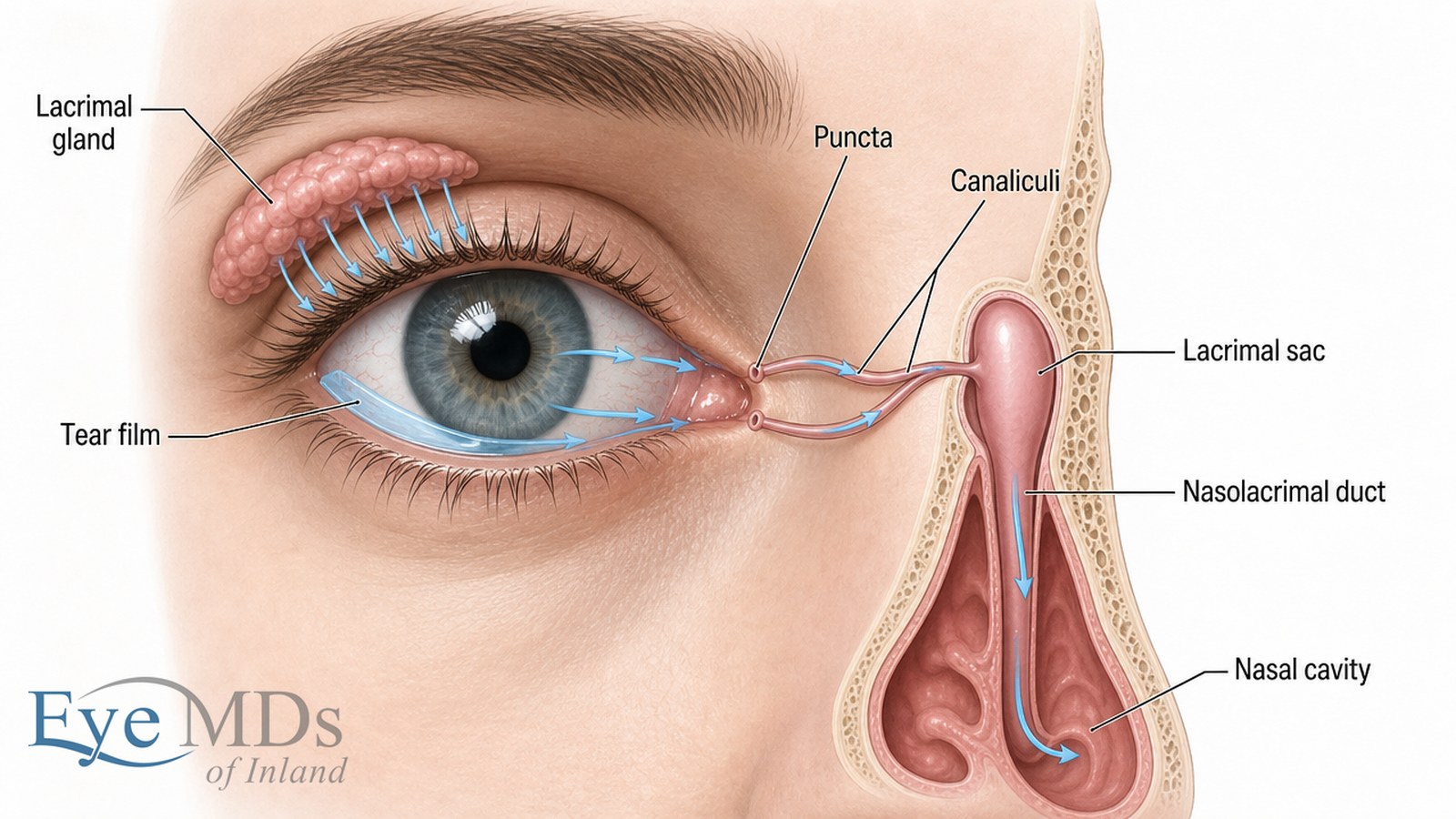
Tears leave the eye through two tiny openings, the puncta, at the inner corner of the eyelids, and drain into the nose. If you make too few tears, letting them drain away is a waste. A punctal plug is a stopper smaller than a grain of rice, placed in the punctum so that your natural tears, and any drops you use, stay on the eye far longer. Plugs are the workhorse treatment for aqueous-deficient dry eye, including Sjogren’s syndrome.
How the doctor puts in eye plugs
The procedure takes a few minutes in the exam chair. The doctor places a numbing drop, measures the punctum with a small gauge to choose the plug size, and may gently dilate the opening. The plug comes preloaded on an applicator; the doctor rests it at the punctum, presses lightly, and the plug seats with its small cap flush against the lid margin. You feel pressure, not pain. We usually start with the lower lids, which carry most of the drainage. You can drive home and use your eyes normally right away.
Dissolvable collagen plugs last from days to months and are useful as a trial. Silicone plugs stay until removed, which takes seconds if tearing becomes excessive.
Lacrifill canalicular gel
Lacrifill is an FDA-cleared alternative to a solid plug. Instead of a stopper at the opening, a hyaluronic acid gel is injected through the punctum to fill the canaliculus, the short channel behind it. Because the gel conforms to the canal, there is no cap on the lid margin to rub and nothing to fall out. Placement takes a few minutes after a numbing drop. Lacrifill typically lasts about six months and can be repeated. It suits patients who found solid plugs uncomfortable or lost them repeatedly.
Prescription eye drops
Chronic dry eye is an inflammatory disease: the dry surface becomes inflamed, the inflammation damages the tear glands and cornea, and the damage causes more dryness. Prescription drops break that cycle.
Anti-inflammatory drops for long-term control
Drops in the cyclosporine or lifitegrast class are used once or twice daily, long term. They quiet immune activity on the surface of the eye and, over two to three months, let the lacrimal gland and surface cells recover and produce more and better tears. They are safe for long-term use and are the foundation of treatment for moderate to severe dry eye of any cause. Because they work slowly, we often pair them with a short steroid course to bridge the gap.
Eysuvis for dry eye flares
Most dry eye patients have flares: a windy week, a long flight, allergy season, late nights at the computer. Eysuvis (loteprednol etabonate ophthalmic suspension 0.25 percent) is a steroid drop FDA-approved for the short-term treatment of the signs and symptoms of dry eye disease. It is used as one to two drops in each eye four times daily for up to two weeks, brings a flare under control within days, and is then stopped. Loteprednol breaks down quickly in the eye, giving it a lower risk of raising eye pressure than older steroids.
Autologous serum tears
Natural tears carry growth factors, vitamin A, fibronectin and other proteins that keep the cornea healthy and help it heal, and no manufactured drop contains them. Autologous serum tears do: a sample of your blood is drawn, the serum is separated and diluted, and a compounding pharmacy bottles it as a preservative-free drop that you keep frozen and use several times a day. Serum tears are reserved for severe dry eye, Sjogren’s syndrome, neurotrophic keratitis (a cornea that will not heal) and surface disease after eye surgery.
Dry eye treatment at home: what works and what does not
Home care will not clear a blocked gland or fix a loose eyelid, but done correctly it supports every other treatment and can keep mild dry eye comfortable.
What works
- Preservative-free artificial tears on a schedule, such as four times a day, rather than only when the eye hurts.
- A lubricating gel or ointment at bedtime for eyes that are worst on waking.
- Warm compresses and lid scrubs with a hypochlorous acid or tea tree based cleanser, daily. Lid hygiene details.
- Omega-3 supplements (fish or flaxseed oil), which improve oil gland secretions over two to three months.
- Blinking and screen breaks. Blink fully and often, look away every 20 minutes, and lower the monitor so you look slightly down.
- Environment. A humidifier at night, wraparound glasses in wind, vents aimed away from the face.
- Medication review. Antihistamines, some antidepressants, diuretics and isotretinoin reduce tear production.
What does not work
Redness-relief drops whiten the eye briefly and make redness rebound; they do nothing for dryness itself. Cucumber slices, castor oil, honey and similar home remedies have no evidence and can introduce infection. Antibiotic drops treat infection, not dry eye. And if you use artificial tears more than four times a day and are still uncomfortable, you need an evaluation, not another bottle.
Marc Shomer, MD, PhD directs treatment planning at the Dry Eye Center for patients from Upland, Rancho Cucamonga, Ontario, Claremont, Montclair, Chino, Pomona, Fontana, San Bernardino and Riverside.
Answers from our dry eye specialists.
How does the doctor put in eye plugs for dry eyes?
In the exam chair, in a few minutes. After a numbing drop, the doctor measures the tear drainage opening (punctum) at the inner corner of the eyelid, rests a preloaded applicator against it and presses gently so the plug seats in place. You feel pressure but not pain, and you can drive home and use your eyes normally right away. Silicone plugs stay until removed; collagen plugs dissolve on their own.
Can you feel punctal plugs?
Most patients do not feel them after the first day. A few notice a scratchy sensation from the plug's cap; the plug can then be removed in seconds and replaced with a different size or with Lacrifill gel, which sits entirely inside the canal.
What is Lacrifill?
Lacrifill is an FDA-cleared hyaluronic acid gel that the doctor injects into the canaliculus, the tear drainage channel just behind the punctum, to keep tears on the eye. It is an alternative to a solid punctal plug with no cap to irritate the lid and nothing to fall out. It typically lasts about six months and can be repeated.
What is Eysuvis and how is it used?
Eysuvis is loteprednol etabonate ophthalmic suspension 0.25 percent, a steroid eye drop FDA-approved for the short-term treatment of the signs and symptoms of dry eye disease. It is used for dry eye flares: one to two drops in each eye four times a day for up to two weeks, then stopped.
What is the best treatment for dry eyes at home?
Preservative-free artificial tears on a schedule, a lubricating ointment at bedtime, daily warm compresses with a lid cleanser, an omega-3 supplement, frequent full blinks during screen use, and a humidifier at night. Castor oil, honey and similar remedies have no evidence and can cause infection. If you need tears more than four times a day, the cause needs to be treated.
Get Treatment That Fits Your Dry Eye
The board-certified ophthalmologists at Eye MDs of Inland offer punctal plugs, Lacrifill, Eysuvis, serum tears, LipiFlow and eyelid surgery in Upland. Serving Rancho Cucamonga, Ontario, Claremont, Montclair, Chino, Pomona, Fontana, San Bernardino and Riverside.