
The Comprehensive Dry Eye Evaluation
Every treatment we offer depends on one question: why are your eyes dry? This visit answers it with measurements, not guesses.
Medically reviewed by Marc Shomer, MD, PhD
How do you know if you have dry eye?
Dry eye rarely feels the way its name suggests. Some patients do describe dryness, but far more come in with burning, stinging, a gritty or sandy feeling, the sense that an eyelash is stuck in the eye, redness, tired eyes at the end of the day, or vision that blurs and then clears with a blink. Many have watery eyes, because an irritated surface triggers reflex tearing. Symptoms are usually worse with reading, computer work, driving, air conditioning, wind and the dry Santa Ana conditions we get in the Inland Empire.
Symptoms alone cannot tell you what kind of dry eye you have, and in many patients the severity of the symptoms does not match the damage on the surface of the eye. That is why the Dry Eye Center at Eye MDs of Inland starts every patient with a dedicated evaluation rather than a trial of drops.
What causes dry eyes?
There are three causes, and the evaluation is built to sort out which ones apply to you:
- Underproduction (aqueous-deficient dry eye). The lacrimal gland makes too little tear volume. Associated with age, menopause, Sjogren’s syndrome and other autoimmune disease, medications such as antihistamines, antidepressants, diuretics and isotretinoin, and prior LASIK.
- Evaporation from oil gland disease. Meibomian gland dysfunction (MGD) leaves the tear film without a healthy oil layer, so tears evaporate quickly. This is the most common cause, present in about 86 percent of dry eye patients, and it travels with blepharitis, Demodex mites and rosacea.
- Eyelid position and closure. Ectropion, entropion, lagophthalmos, floppy eyelid, ptosis or scarring prevent the lid from spreading and holding the tear film.
What happens during the evaluation
Plan on a longer visit than a routine eye exam. Each step below adds a piece of the picture, and together they tell us which cause, or combination of causes, is behind your symptoms.
History and symptom questionnaire
You will complete a standardized symptom score such as the SPEED or OSDI questionnaire. It gives us a number we can track over time to confirm that treatment is working. We review your medical history, contact lens use, past eye surgery including LASIK, and every medication you take, since several common drugs reduce tear production.
Slit-lamp examination
Under high magnification we examine the eyelid margins, the lashes, the openings of the meibomian glands, the conjunctiva and the cornea. We look specifically for collarettes, the cylindrical dandruff at the base of the lashes that is the signature of Demodex mites, and for the redness and capped gland openings of blepharitis.
Tear break-up time (TBUT)
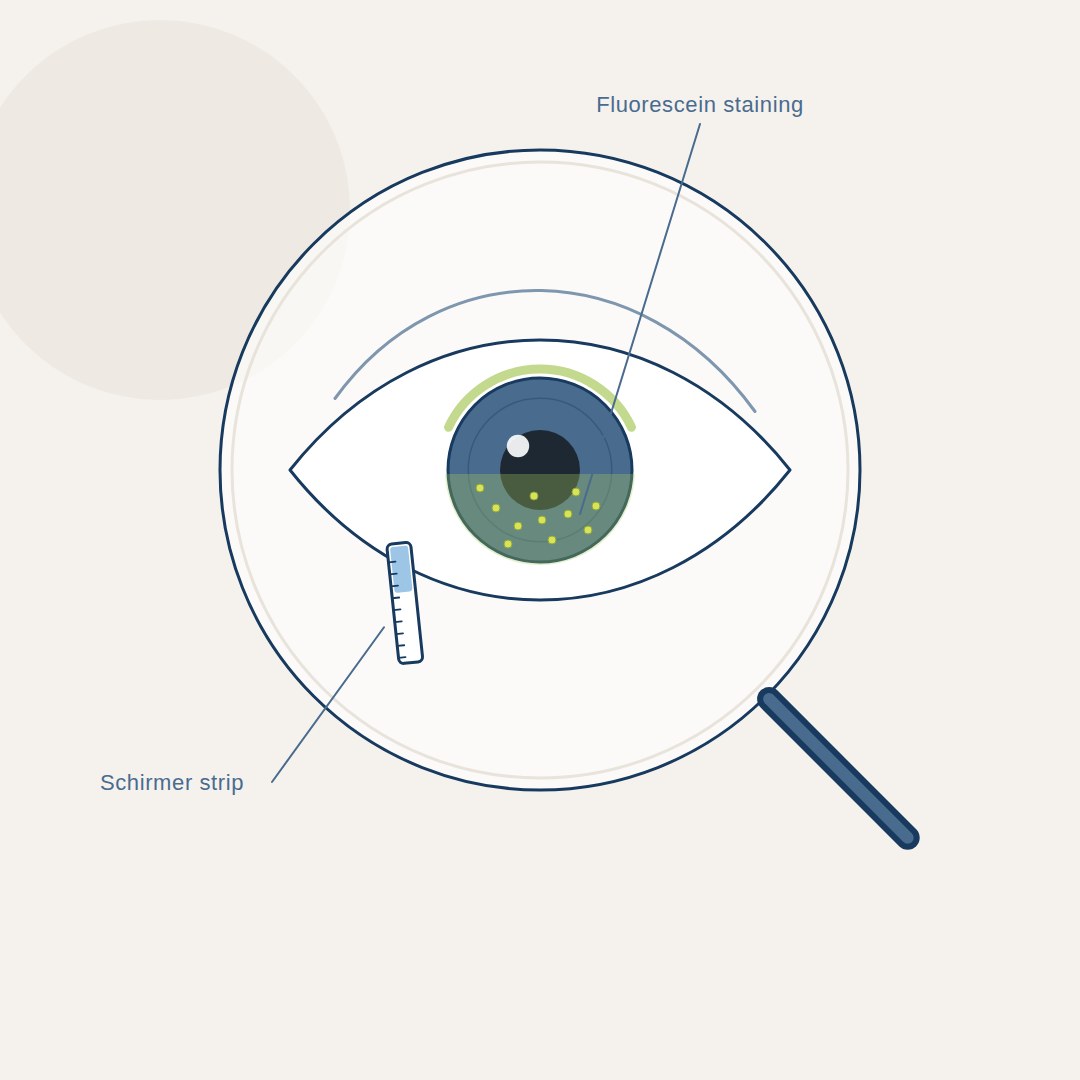
A small amount of fluorescein dye is placed on the eye and we time how long the tear film stays intact between blinks. A tear film that breaks up in under ten seconds is unstable, and a very short break-up time points toward an evaporative, oil-deficient problem.
Fluorescein and lissamine green staining
These two dyes highlight areas where the surface cells of the cornea and conjunctiva have been damaged by dryness. The pattern of staining helps distinguish underproduction, evaporation and exposure from an eyelid that does not close.
Schirmer test
A thin strip of paper is placed under the lower lid for five minutes to measure how much tear fluid you produce. A low Schirmer value is the hallmark of aqueous-deficient dry eye and raises the question of Sjogren’s syndrome.
Meibomian gland expression and meibography
We press gently on the eyelid to see whether the glands release clear oil, thick paste, or nothing at all. Meibography, an infrared image of the glands inside the eyelid, shows how many glands are still present and how many have shortened or dropped out. Gland loss is permanent, which is why we want to find MGD before it gets that far. Learn more about MGD and LipiFlow.
Eyelid position, blink and closure
We check whether the lids sit against the eye, whether they turn in or out, whether you close completely when you blink and when you sleep, and whether the lids are unusually loose. When the eyelid is the problem, drops will not solve it. Read about eyelid surgery for dry eye.
Blood work and additional testing
If low tear production is combined with dry mouth, joint pain, fatigue or a known autoimmune disease, we refer for blood work (SS-A/Ro, SS-B/La, ANA and rheumatoid factor) to evaluate for Sjogren’s syndrome. Tear osmolarity and MMP-9 inflammation testing are used when indicated.
What you leave with
At the end of the visit Marc Shomer, MD, PhD or Robert Gunzenhauser, MD will explain which of the three causes applies to you and lay out a treatment plan matched to each one. For blocked oil glands that may mean LipiFlow and lid hygiene. For Demodex, a six-week course of Xdemvy. For low tear volume, punctal plugs or Lacrifill and a prescription anti-inflammatory drop. For an eyelid that does not close or sits away from the eye, a surgical repair. Most patients need a combination, and we set a follow-up schedule to measure the response with the same tests we used at the start.
You do not need a referral to schedule a dry eye evaluation, and most medical insurance plans, including Medicare, cover the visit as a medical eye examination. Bring a list of your medications and any drops you have already tried.
Answers from our dry eye specialists.
How do I find a dry eye specialist?
Choose an ophthalmologist whose office performs a full dry eye workup (tear break-up time, dye staining, a Schirmer test, meibomian gland expression and meibography, and an eyelid assessment) and can then offer the treatments the findings call for, from LipiFlow and punctal plugs to eyelid surgery. Eye MDs of Inland in Upland provides all of this in one location.
How do I know if I have dry eye or something else?
Burning, grittiness, a lash-in-the-eye feeling, redness, tired eyes and vision that clears when you blink are the classic symptoms, and watering is common too. Allergies, blepharitis, contact lens problems and an inturned lash can feel similar and often coexist. Only an examination with dye staining, tear film measurements and a look at the eyelids can tell them apart.
What causes dry eyes?
Three things. Either the tear gland makes too little fluid (age, menopause, Sjogren's syndrome, certain medications, LASIK), the eyelid oil glands are blocked so tears evaporate too fast (meibomian gland dysfunction, present in about 86 percent of cases), or the eyelids cannot close and spread the tears properly. The evaluation identifies which applies to you.
Does the dry eye evaluation hurt?
No. The dyes, the Schirmer strip and gland expression may feel briefly odd, but no test requires needles or anesthesia beyond a numbing drop, and there is no recovery time. Plan for a visit that is longer than a routine exam.
Is a dry eye evaluation covered by insurance?
The evaluation is a medical eye examination and is generally covered by medical insurance and Medicare, subject to your plan's copay and deductible. Some in-office treatments that may be recommended afterward, such as LipiFlow, are typically not covered, and we review that with you before anything is scheduled.
Start with the Right Diagnosis
Schedule a comprehensive dry eye evaluation with the board-certified ophthalmologists at Eye MDs of Inland in Upland. Serving Rancho Cucamonga, Ontario, Claremont, Montclair, Chino, Pomona, Fontana, San Bernardino and Riverside.