
Most people who reach for eye drops are trying to feel better. It surprises patients to learn that the drops themselves are a common reason an eye stays dry. The Tear Film and Ocular Surface Society (TFOS) Dry Eye Workshop II report on iatrogenic dry eye lists topical medications among the leading treatment-caused contributors to dry eye disease.
Important: do not stop any prescribed eye drop without talking to your eye doctor first. This matters most for glaucoma drops. Stopping them on your own can allow eye pressure to rise and cause permanent vision loss.
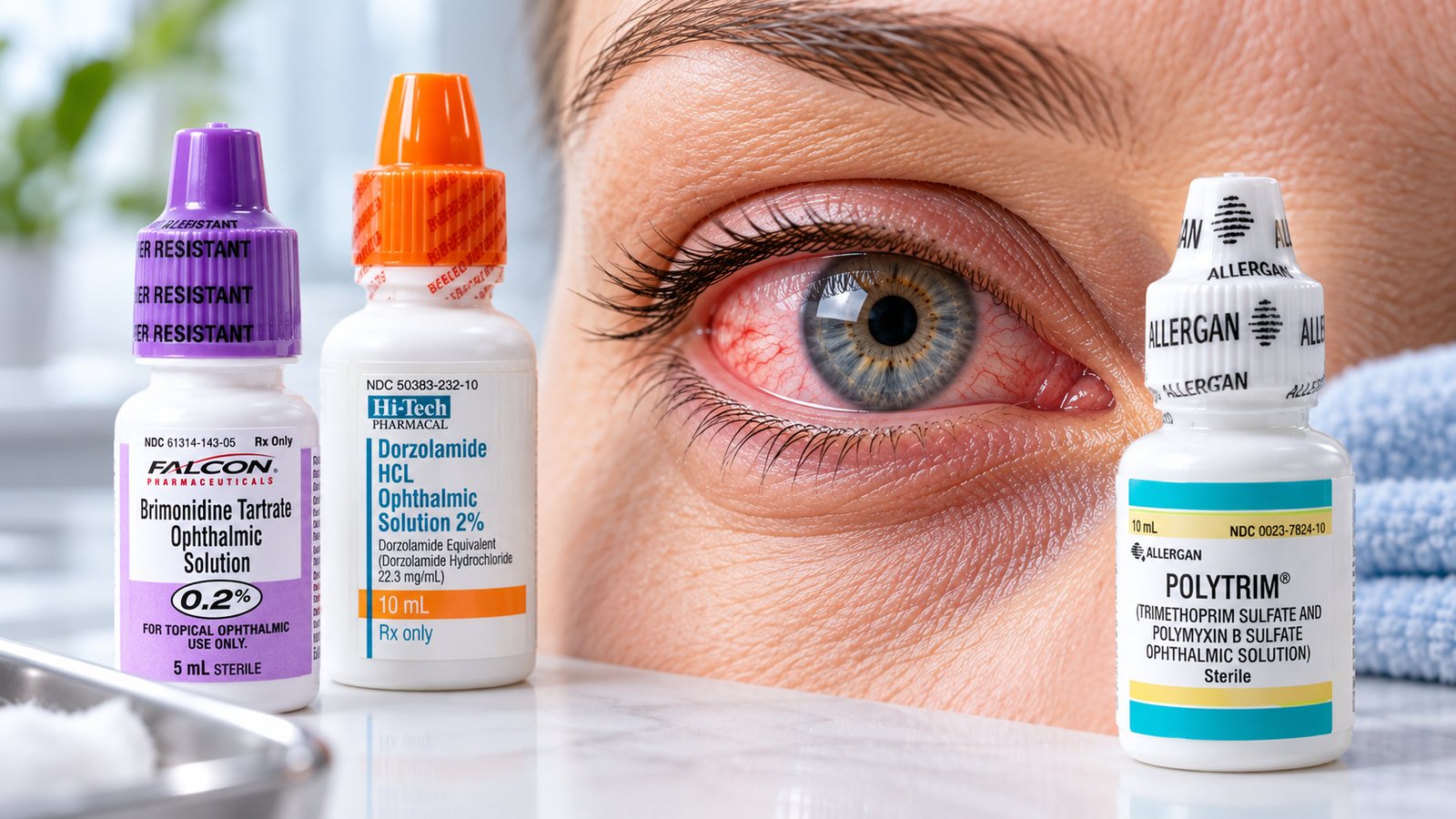
Below, organized by category, are the drops we see causing trouble at the Dry Eye Center in Upland, with generic names and common brands so you can check your own medicine cabinet.
1. Redness relievers (vasoconstrictors)
These drops shrink surface blood vessels so the eye looks white. They do nothing for the cause of the redness, and with repeated use the vessels dilate again as the drug wears off, a pattern called rebound redness. Most bottles also contain the preservative benzalkonium chloride (BAK).
- Tetrahydrozoline (Visine Original, Visine-A)
- Naphazoline (Clear Eyes, Naphcon-A, Opcon-A)
- Brimonidine 0.025 percent (Lumify): less rebound in trials, but the bottle is still preserved with BAK and is labeled for no more than four doses a day and no more than three days without seeing a doctor
2. Preserved artificial tears used many times a day
Multi-dose bottles need a preservative to stay sterile, and the most common one is benzalkonium chloride (BAK). BAK is a detergent: it strips the oily layer of the tear film, lowers the number of mucus-producing goblet cells, and is toxic to surface cells at the concentrations found in many bottles. One or two drops a day is usually tolerated. Six or eight can turn a mild dry eye into a raw one.
- Many standard Visine, Clear Eyes, store-brand, Refresh, Systane and TheraTears bottles are preserved. Check the label for "benzalkonium chloride".
- Our rule: if you need tears more than four times a day, switch to preservative-free single-use vials or a preservative-free multi-dose bottle.
3. Glaucoma drops
Glaucoma drops are taken daily for life, so the preservative dose adds up. Surveys report ocular surface disease in roughly 30 to 70 percent of treated glaucoma patients. Three mechanisms:
- BAK-preserved prostaglandins such as latanoprost (Xalatan), bimatoprost (Lumigan) and travoprost (Travatan Z uses a different preservative)
- Beta blockers such as timolol (Timoptic, and combinations like Cosopt and Combigan) reduce tear production; a classic study found lower Schirmer scores and shorter tear break-up time (TBUT) after starting timolol
- Brimonidine (Alphagan) causes an allergic follicular conjunctivitis in as many as one in four users, which looks and feels like severe dry eye
Never stop glaucoma drops on your own. Our glaucoma division, the Inland Glaucoma Center, can switch you to preservative-free formulations or to selective laser trabeculoplasty (SLT), an in-office laser that lowers pressure without daily drops. Call 909-315-6891.
4. Antihistamine and allergy drops
Antihistamines block itch but also reduce tear secretion, and the bottles are preserved. Oral antihistamines such as diphenhydramine (Benadryl), cetirizine (Zyrtec) and loratadine (Claritin) dry the eye from the inside as well.
- Ketotifen (Zaditor, Alaway)
- Olopatadine (Pataday, Patanol)
- Antihistamine plus vasoconstrictor combinations (Visine-A, Naphcon-A, Opcon-A)
5. Steroid drops used long term without supervision
Prednisolone (Pred Forte), dexamethasone and loteprednol drops calm inflammation quickly, which is why we prescribe short courses for dry eye flares. Used for months without follow-up, they can raise eye pressure, accelerate cataract, and mask infection. Steroid drops should always have an end date and a pressure check.
6. Antibiotic and antiviral drops
These are meant for short courses. Continued for weeks, several are directly toxic to the cornea, producing toxic keratoconjunctivitis.
- Aminoglycosides: gentamicin (Garamycin), tobramycin (Tobrex), neomycin combinations (Neosporin ophthalmic)
- Trifluridine (Viroptic), the antiviral used for herpes keratitis, which is limited to about three weeks on its label for this reason
7. Anesthetic drops
Proparacaine (Alcaine) and tetracaine numb the eye for exams and procedures. They are never for home use. Repeated dosing stops the cornea from healing and can end in ulcers, permanent scarring or perforation.
8. Dilating drops and miotics
Exam-day dilating drops (tropicamide, phenylephrine) cause only a few hours of dryness and light sensitivity. Pupil-constricting miotics such as pilocarpine, including the presbyopia drop Vuity, are used daily and can cause burning and redness in dry eyes.
9. Contact lens rewetting drops and multipurpose solutions
Preserved rewetting drops and multipurpose cleaning solutions leave preservatives such as polyquaternium-1 and polyhexamethylene biguanide (PHMB) in the lens matrix, where they sit against the cornea all day. Preservative-free rewetting vials and hydrogen peroxide cleaning systems (Clear Care) are gentler choices.
What to use instead
- Preservative-free artificial tears in single-use vials (Refresh Plus, Systane Ultra PF, TheraTears PF, Oasis Tears) can be used as often as needed.
- Eysuvis (loteprednol etabonate 0.25 percent), FDA-approved for short-term treatment of dry eye flares, up to two weeks.
- Tyrvaya (varenicline nasal spray): one spray in each nostril twice daily triggers natural tear production through the nasal nerves, with nothing placed on the eye.
- Tryptyr (acoltremon 0.003 percent), approved in 2025, is a preservative-free drop that activates cold-sensing nerves on the cornea to boost tear production, one drop twice daily.
- Cyclosporine or lifitegrast class anti-inflammatory drops treat the inflammation underneath chronic dry eye.
These options, plus punctal plugs, Lacrifill, serum tears and LipiFlow, are described on the dry eye treatments page.
How the Dry Eye Center finds drop-related toxicity
Every patient at the Dry Eye Center starts with a comprehensive dry eye evaluation that answers one question: why is this eye dry? Medication toxicity tends to stain the lower third of the cornea and the conjunctiva in the gap between the lids with fluorescein and lissamine green, while allergy shows follicles under the lower lid. We review every eye drop, nasal spray and oral medication you take, measure tear production with the Schirmer test, check TBUT, and image the meibomian glands, because a medication can be the whole story or just one of the three causes, alongside underproduction (as in Sjogren's syndrome) and meibomian gland dysfunction.
Once more, because it matters: do not stop any prescribed eye drop without talking to your eye doctor first. For glaucoma drops, stopping on your own can cause permanent vision loss. Bring the bottles to the Dry Eye Center, and we will build a plan that protects both your pressure and your surface.
Works Cited
1. Gomes JAP, Azar DT, Baudouin C, et al. TFOS DEWS II iatrogenic report. The Ocular Surface. 2017;15(3):511-538.
2. American Academy of Ophthalmology EyeWiki. Preservatives in Topical Ophthalmic Medications.
3. Bausch + Lomb. LUMIFY Redness Reliever Eye Drops (brimonidine tartrate 0.025%) Drug Facts label. DailyMed, National Library of Medicine.
4. Hosten LO, Snyder C. Over-the-Counter Ocular Decongestants in the United States: Mechanisms of Action and Clinical Utility for Management of Ocular Redness. Clinical Optometry. 2020;12:95-105.
5. Blondeau P, Rousseau JA. Allergic reactions to brimonidine in patients treated for glaucoma. Canadian Journal of Ophthalmology. 2002;37(1):21-26.
6. Paley GL, Lubniewski AJ, Reidy JJ, Farooq AV. Toxic Keratoconjunctivitis. Eye & Contact Lens. 2018;44 Suppl 1:S8-S15.
7. Bonomi L, Zavarise G, Noya E, Michieletto S. Effects of timolol maleate on tear flow in human eyes. Graefe's Archive for Clinical and Experimental Ophthalmology. 1980;213(1):19-22.