
Meibomian Gland Dysfunction and LipiFlow
Blocked oil glands in the eyelids are behind most dry eye. Find out how we image, express and clear them before gland loss becomes permanent.
Medically reviewed by Marc Shomer, MD, PhD
What is meibomian gland dysfunction?
Your tear film has three layers. The innermost mucus layer lets tears stick to the eye, the middle watery layer makes up most of the volume, and the outer oil layer seals it in so it does not evaporate between blinks. That oil comes from the meibomian glands, about 25 to 40 vertical glands inside each upper eyelid and 20 to 30 in each lower lid, which release a thin, clear oil called meibum every time you blink.
Meibomian gland dysfunction (MGD) is what happens when those glands stop delivering healthy oil. The openings become capped with keratin, the meibum thickens from olive oil to toothpaste, the glands back up and become inflamed, and eventually they shrink and disappear. Without an oil layer, tears evaporate in seconds, the surface dries out between blinks, and the eye responds with burning, grittiness, fluctuating vision and reflex watering. This is evaporative dry eye, and it is the most common form: the landmark study by Lemp and colleagues (Cornea, 2012) found an evaporative or MGD component in about 86 percent of dry eye patients.
Who gets MGD?
Almost everyone develops some gland changes with age, but MGD comes earlier and hits harder in people with rosacea, with anterior blepharitis or Demodex mites, with heavy screen use (we blink about a third as often while looking at a screen, so the glands are not emptied), with long-term contact lens wear, and in people who use eye makeup along the lash line. Certain medications, including isotretinoin, also damage the glands. Recurring styes and chalazia are a strong clue that the glands are blocked.
Why treat early
A blocked gland can be cleared. A gland that has atrophied cannot be brought back. Meibography lets us see exactly how many glands you have left, and that number only moves in one direction. Patients who wait until their symptoms are severe often arrive with half of their glands already gone, which limits what any treatment can do. The goal of the Dry Eye Center is to find MGD while the glands are still salvageable.
How we diagnose MGD
MGD is evaluated as part of every comprehensive dry eye evaluation. Three findings matter most.
Meibomian gland expression
At the slit lamp the doctor presses gently on the eyelid margin with a fingertip or a small paddle and watches what comes out of the gland openings. Healthy glands release a clear, thin oil with light pressure. In MGD the secretion is cloudy, thick or granular, or nothing comes out at all. Diagnostic expression tells us how obstructed the glands are and how the oil quality compares from visit to visit. Therapeutic expression, done after the glands are warmed, is a treatment in itself.
Meibography
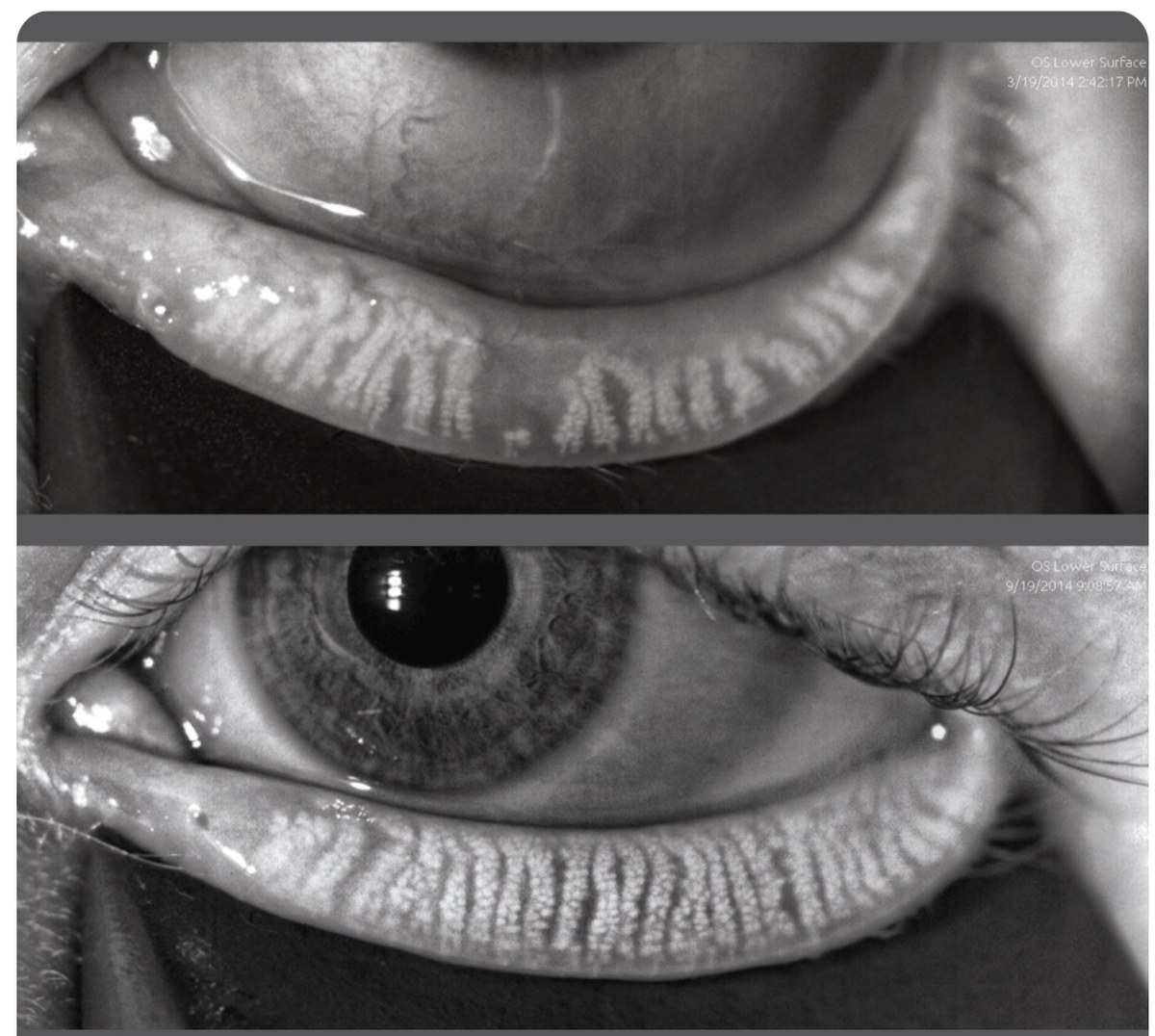
An infrared camera images the glands through the everted eyelid, showing them as pale vertical stripes. We can count the glands, measure how many have shortened, and identify dropout, the dark areas where glands used to be. Meibography turns an invisible problem into a picture you can see, and it is the single best predictor of how well your glands will respond to treatment.
Tear break-up time and lid margin findings
A short tear break-up time (TBUT), typically under ten seconds, confirms that the tear film is unstable. Capped gland openings, foamy tears, thickened or notched lid margins, and telangiectasia (fine dilated vessels along the lid edge) all point toward MGD, and the presence of collarettes at the lash base tells us Demodex mites are contributing.
LipiFlow thermal pulsation
Warm compresses at home are the traditional treatment for MGD, and they help, but a washcloth cools within a minute and cannot reach the temperature needed to melt hardened meibum inside the gland. LipiFlow was designed to solve that problem.
LipiFlow is a 12-minute in-office treatment. After a numbing drop, a single-use activator is placed over each eye. Its inner surface rests against the inside of the eyelid, directly over the glands, and warms them to 42.5 degrees Celsius (about 108 degrees Fahrenheit), the temperature at which thickened oil liquefies. At the same time the outer surface applies gentle, pulsing pressure to the outside of the lid, milking the softened contents out of the gland openings. The eye itself is protected by an insulated dome and is never heated. Most patients describe it as a warm eyelid massage.
There is no downtime. You can drive yourself home and return to normal activities immediately. Improvement in symptoms typically builds over the following four to eight weeks as the cleared glands resume producing oil, and the effect commonly lasts a year or longer, at which point the treatment can be repeated. LipiFlow works best when the glands are blocked rather than lost, which is why we image them first and why we recommend it earlier rather than later.
Supporting treatments
LipiFlow clears the glands; the rest of the plan keeps them open. Depending on your findings this may include daily warm compresses and lid scrubs with a hypochlorous acid or tea tree based cleanser, omega-3 supplements to improve oil quality, a short course of prescription anti-inflammatory drops or Eysuvis to settle the lid margin, and Xdemvy when Demodex mites are present. If our evaluation also shows low tear production, punctal plugs or Lacrifill can be added. Marc Shomer, MD, PhD performs LipiFlow and directs every MGD treatment plan.
Answers from our dry eye specialists.
What is MGD?
MGD stands for meibomian gland dysfunction, a condition in which the oil glands inside the eyelids become blocked or stop producing healthy oil. Without that oil layer, tears evaporate too quickly, causing burning, grittiness, fluctuating vision and watery eyes. MGD is the leading cause of dry eye, present in about 86 percent of dry eye patients.
What does meibomian gland expression do?
Expression means pressing on the eyelid to push oil out of the meibomian glands. As a test it shows whether the glands release clear oil, thick paste or nothing, which grades how obstructed they are. As a treatment, expression after the glands are warmed, as in LipiFlow, clears the blockage so the glands can function again.
Does LipiFlow hurt?
No. A numbing drop is placed first, and most patients describe the 12-minute treatment as a warm eyelid massage with some pressure. The eye is protected by an insulated shield and is never heated. There is no downtime, and you can drive yourself home.
How long does LipiFlow last?
Improvement usually builds over four to eight weeks and commonly lasts a year or more, depending on how much gland damage was already present and how well you keep up with home care. The treatment can be repeated when symptoms return.
Can meibomian glands grow back?
No. Glands that have atrophied do not regenerate. Blocked glands can be cleared and recover their function, which is why we image the glands with meibography and recommend treating MGD early, while most glands are still present.
Are warm compresses enough to treat MGD?
Compresses help maintain gland function and are part of nearly every MGD plan, but a washcloth loses heat within a minute and rarely melts hardened oil deep in the gland. For established blockage, an in-office treatment such as LipiFlow clears the glands far more completely, and compresses then help keep them open.
Treat MGD Before Gland Loss Is Permanent
Eye MDs of Inland offers meibography, gland expression and LipiFlow thermal pulsation in Upland. Serving Rancho Cucamonga, Ontario, Claremont, Montclair, Chino, Pomona, Fontana, San Bernardino and Riverside.