
The enVista Envy is Bausch + Lomb's entry into the "full range of vision" category of lens implants, the group of trifocal-style lenses that aim to give cataract patients clear distance, computer and reading vision without glasses. The FDA approved it on October 14, 2024, and it became broadly available in the United States during 2025. Since then, two large randomized trials have been published, and we now have real numbers to discuss with patients rather than marketing language.
This guide covers what the Envy lens is, how it is built, what the trials showed for vision and side effects, who tends to be a good candidate, how it compares with PanOptix Pro, Odyssey and the extended depth of focus lenses, and what it costs.

What Is the enVista Envy IOL?
During cataract surgery the cloudy natural lens is replaced with an artificial intraocular lens (IOL). The Envy (model EE, with the toric version designated model ET) is a diffractive multifocal lens: concentric rings on its surface split light into distance, intermediate and near focal points. It is built on the enVista platform, a hydrophobic acrylic lens design that Bausch + Lomb has used for years and that is known for excellent rotational stability, which matters for the toric (astigmatism correcting) version.
Three design features distinguish it:
- ActivSync Optic. Bausch + Lomb's name for the way the lens distributes light energy between its focal points as lighting conditions, and therefore pupil size, change. The company describes it as shifting more energy toward distance in dim light, which is intended to keep night vision cleaner and reduce halos.
- A continuous plateau rather than separate peaks. The Envy was engineered so that vision stays nearly constant from arm's length in to reading distance, instead of dipping between an intermediate and a near focal point. Our Lens Simulator & Guide (opens in a new tab) shows how a multifocal design like this compares with a monofocal and an EDOF lens.
- A toric version with fine steps. The Envy Toric corrects astigmatism in 0.5 diopter steps (or smaller) across its cylinder range, which allows more precise correction. The non-toric lens is intended for eyes with 1.0 diopter or less of corneal astigmatism.
What the Clinical Trials Showed
The U.S. pivotal trial
The FDA trial, published in the American Journal of Ophthalmology in 2025, randomized 501 patients at multiple U.S. centers to receive the Envy in both eyes (332 patients) or the standard enVista monofocal lens in both eyes (169 patients). At four to six months after surgery:
- Distance vision with the Envy was equivalent (statistically non-inferior) to the monofocal lens.
- Intermediate (66 cm) and near (40 cm) vision were statistically superior to the monofocal lens, with both eyes together and each eye alone.
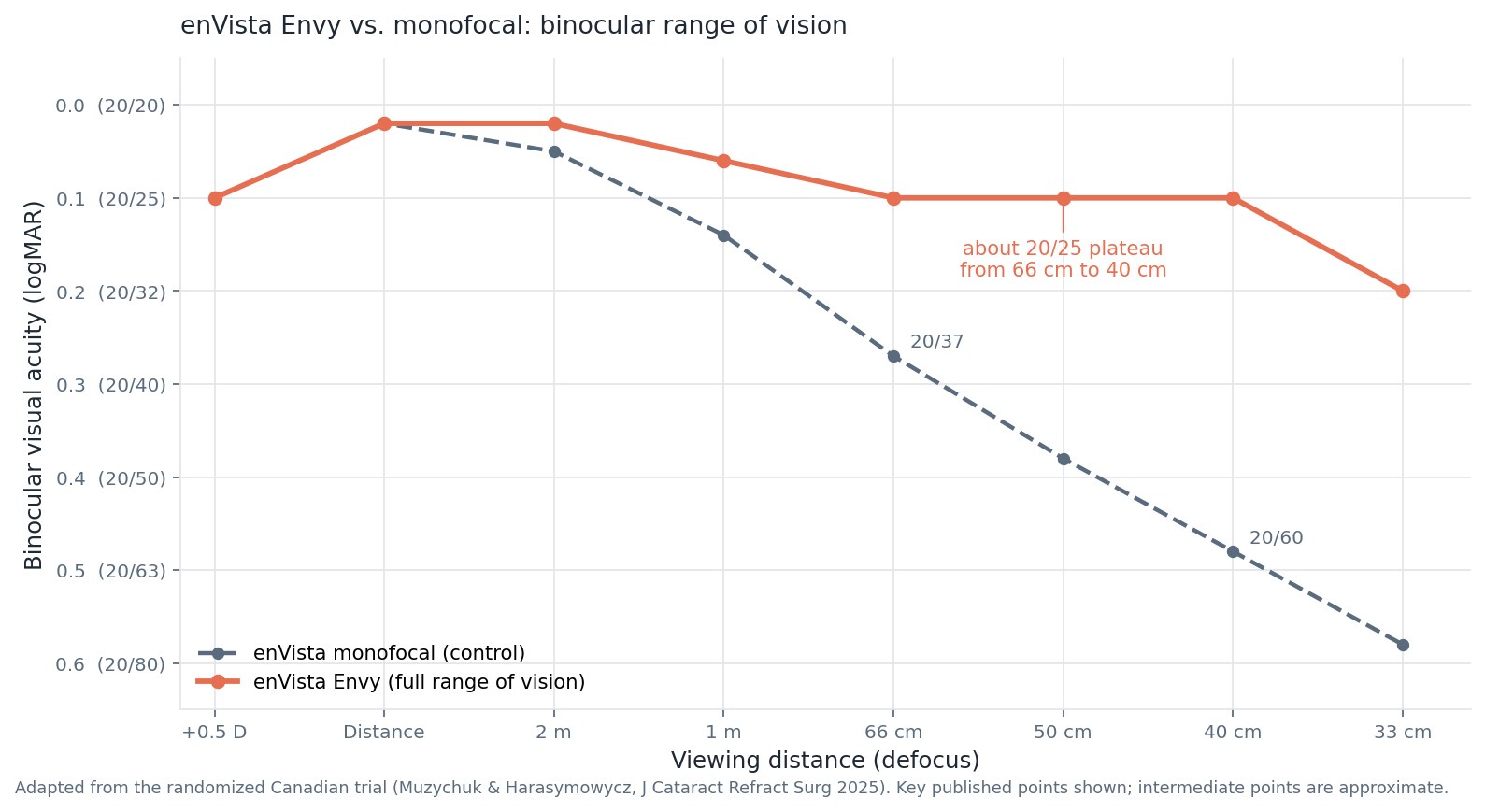
- Binocular vision was 20/25 or better across the entire range from distance to 40 cm.
- Contrast sensitivity in dim light differed from the monofocal by less than the smallest detectable amount, which is unusually good for a diffractive lens.
- Night vision symptoms: 86% of Envy patients reported little to no bothersome glare, halos or starbursts.
The Canadian randomized trial
A separate double-masked trial at nine Canadian centers, published in the Journal of Cataract & Refractive Surgery in October 2025, produced the clearest picture of the lens's range. Envy patients had about 4.0 diopters of usable range (20/32 or better), and vision plateaued at roughly 20/25 from 66 cm to 40 cm. Monofocal patients in the same study fell to about 20/37 at 66 cm and 20/60 at 40 cm. After surgery, 92.7% of Envy patients were satisfied with their near vision, and 91.7% did not need glasses for near tasks, even for extended periods.
What Vision Can You Realistically Expect?
- Distance (driving, television, golf): excellent, equal to a standard lens.
- Intermediate (computer, dashboard, cooking): excellent, around 20/25.
- Near (phone, menus, books): strong, around 20/25 at 40 cm. This is the reason to choose a trifocal-style lens over an extended depth of focus lens. Compare the two in the Lens Simulator.
- Night vision: better than older multifocals, but not the same as a monofocal or a non-diffractive EDOF lens. About one in seven patients in the U.S. trial reported some bother from glare, halos or starbursts. Most patients adapt over the first months.
Who Is a Good Candidate?
The Envy suits patients who:
- Want the strongest possible chance of reading without glasses, and are willing to accept some halos at night in exchange
- Have healthy eyes: a clear cornea, a healthy macula, and no significant glaucoma
- Have a good tear film, or are willing to treat dry eye before surgery, because diffractive lenses are unforgiving of a poor ocular surface
- Have astigmatism, since the Envy Toric corrects it in the same surgery
- Are motivated and patient about neuroadaptation, the process by which the brain learns to ignore halos and use all three focal points
We generally steer patients away from any diffractive lens, including the Envy, when they have moderate or advanced glaucoma, macular degeneration, significant corneal irregularity, or a history of being extremely sensitive to night glare. For those patients a non-diffractive EDOF lens or a monofocal lens, sometimes with mini-monovision, is usually the better plan.
How the Envy Compares to the Other 2026 Options
Envy vs. PanOptix and PanOptix Pro (Alcon)
These are the closest competitors: both are diffractive trifocal-style lenses that deliver strong near vision. PanOptix has the longest track record of any trifocal in the United States, and PanOptix Pro refined its light distribution. The Envy's distinguishing claims are the pupil-dependent ActivSync design, the continuous plateau between intermediate and near, and the fine-step toric range. Published direct comparisons between the two are still limited, so the choice often comes down to your measurements and your surgeon's experience with each platform.
Envy vs. Odyssey (Johnson & Johnson)
Odyssey is J&J's newest full range diffractive lens. Like the Envy, it targets continuous vision from distance to near with reduced halos compared with earlier generations. Both are excellent options for the motivated, healthy-eyed patient who wants to read without glasses.
Envy vs. PureSee and Vivity (non-diffractive EDOF)
This is the real fork in the road. PureSee and Vivity have no rings, so their halo and contrast profiles are close to a monofocal lens, but their near vision is functional rather than strong. The Envy gives you more reading power; the EDOF lenses give you cleaner nights. Our EDOF vs. multifocal comparison lays out the published numbers side by side.
Envy vs. the Light Adjustable Lens (RxSight)
The Light Adjustable Lens is fine-tuned with light treatments after surgery, which makes it the precision choice for eyes with prior LASIK or radial keratotomy. It offers superb image quality but a narrower range of focus than the Envy and requires several office visits for adjustments.
The best way to understand these differences is to look at them. Our interactive Lens Simulator & Guide shows a daytime scene and a night driving scene through a monofocal, an EDOF and a multifocal design, with adjustable astigmatism, so you can see for yourself what "halos" and "reading distance" actually mean before your visit.
Free app: the Cataract Surgery Guide for iPhone and Android
Our free Cataract Surgery Guide app includes the same two-eye lens simulator, a plain-language explanation of every lens category, what to expect on surgery day, and optional eye drop reminders. It is completely free, requires no account, and collects no personal information.
What Does the Envy Lens Cost?
Medicare and most insurance cover the standard portion of cataract surgery, which includes a quality monofocal lens. The Envy is a presbyopia correcting premium lens, so the upgrade is paid out of pocket, the same as PanOptix, Odyssey or PureSee. Nationally, premium lens packages commonly add roughly $1,500 to $3,500 per eye beyond the covered portion, depending on the practice and whether astigmatism correction and laser assistance are bundled. At Eye MDs of Inland, our all-inclusive price for the enVista Envy upgrade is $2,695 per eye, the same as for the TECNIS PureSee. We confirm the exact figure for your eyes at your consultation.
How We Help You Decide
At Eye MDs of Inland in Upland, every lens recommendation begins with measurements: corneal topography, optical biometry, tear film evaluation, and imaging of the macula and optic nerve. If your eye is not a good match for a diffractive lens, we will tell you before surgery. If it is, the Envy is one of the strongest full range options available in 2026, and for the patient who wants to put reading glasses away for good, it is a lens we are glad to have.
Related reading: The RayOne Galaxy spiral IOL: what the FDA trial and published studies show. The FDA approved this new spiral lens implant in September 2026.
Works Cited
1. Bausch + Lomb. Bausch + Lomb receives FDA approval for enVista Envy full range of vision intraocular lens. Press release, October 14, 2024.
2. Shultz MC, Wiley WF, Liang E, Epitropoulos AT, Whitman J. Visual and patient-reported outcomes of a novel full visual range intraocular lens versus a monofocal intraocular lens: a randomized multicenter US trial. American Journal of Ophthalmology. 2025;280:493-507.
3. Muzychuk A, Harasymowycz P. Efficacy and safety evaluation of a new full visual range vs monofocal intraocular lens in patients with cataract: randomized, controlled Canadian clinical trial. Journal of Cataract & Refractive Surgery. 2025;51(10):867-875.
4. Healio Ocular Surgery News. FDA approves enVista Envy IOL from Bausch + Lomb. October 2024.
