
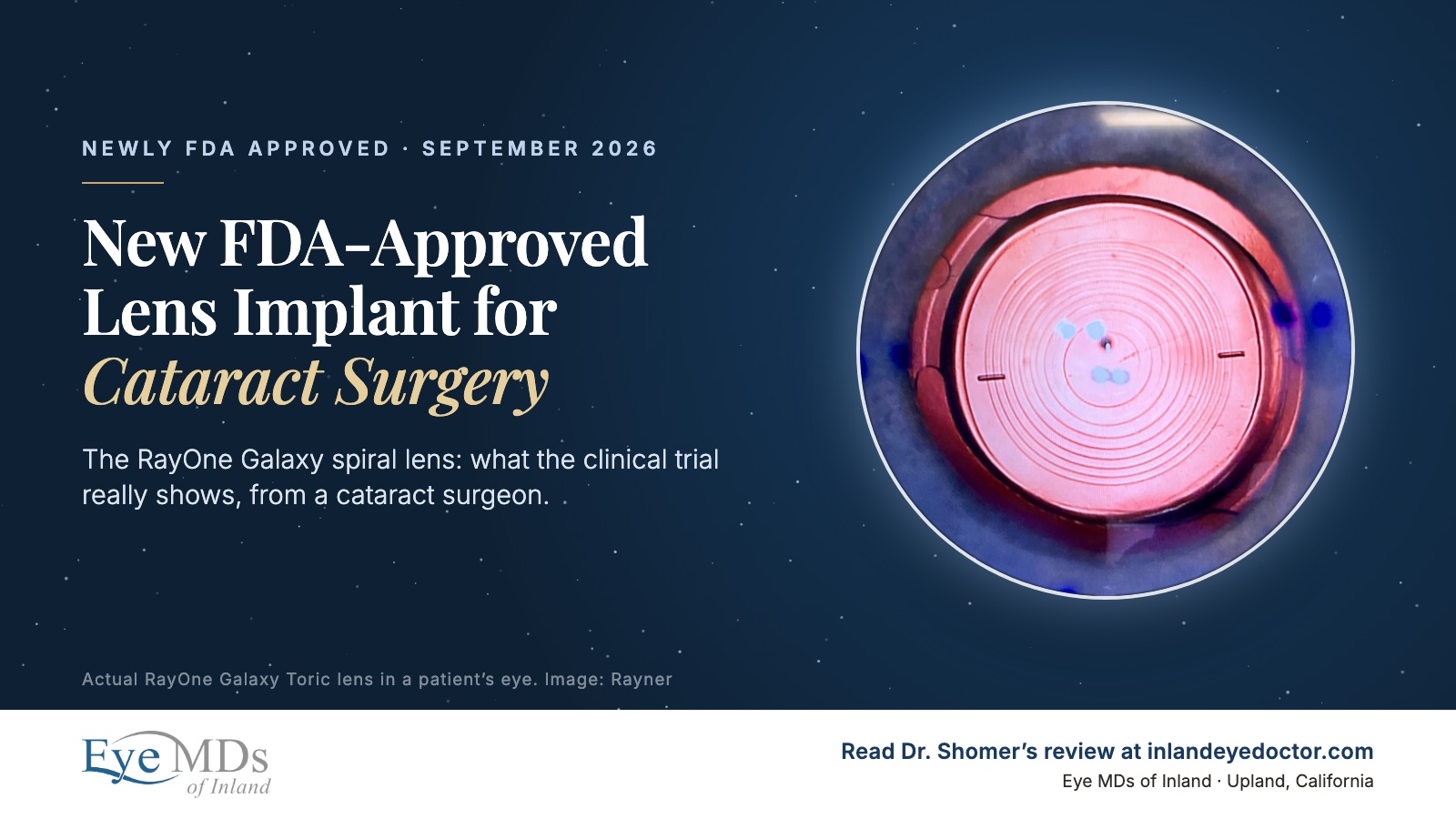
On September 24, 2026, the FDA approved the RayOne Galaxy and RayOne Galaxy Toric, a new lens implant for cataract surgery from the British manufacturer Rayner. It is the first lens implant built around a spiral instead of rings, and patients are already asking me about it. This guide explains what the Galaxy is, what vision you can realistically expect, who is a good candidate, who is not, how it compares with the other 2026 lenses, and what it costs. I am not implanting it yet, and I explain why below.
The short version
- What it is: An intraocular lens (IOL) that uses a smooth spiral surface to add computer and reading vision with less need for reading glasses.
- What it does well: in the FDA trial, with both eyes open and no glasses, 86.2% of Galaxy patients read 20/32 or better at 16 inches. Only 11.9% of patients with a monofocal lens did.
- What it costs you in vision: distance is slightly less crisp than with a monofocal lens, and halos are more common. With both eyes open and no glasses, 29.4% of Galaxy patients saw 20/20 at distance, compared with 68.8% of monofocal lens patients.
- What to expect afterward: about 1 in 5 Galaxy eyes needed a quick laser treatment (YAG capsulotomy) within six months, compared with about 1 in 14 monofocal lens eyes.
- Astigmatism: the Galaxy Toric corrects roughly 1.0 to 3.0 diopters of corneal astigmatism.
How the Galaxy Compares with Other Premium Lenses
No randomized trial has yet compared the Galaxy directly with another premium lens. What I can do is set each lens's own FDA trial side by side. These are different trials with different patients and questionnaires, so treat this as a rough guide, not a ranking.
| FDA trial, both eyes, distance glasses only | Computer (66 cm) | Reading (40 cm) | Very bothered by halos* |
|---|---|---|---|
| PanOptix (Alcon trifocal, 2019) | about 20/20 | about 20/22 | 2.4% |
| RayOne Galaxy (2026) | about 20/23 | about 20/30 | 5.5% |
| Vivity (Alcon EDOF, 2020) | about 20/23 | about 20/36 | 0.9% |
| TECNIS PureSee (J&J EDOF, 2026) | about 20/25 | about 20/38 | 2.7% |
Sources: FDA Summaries of Safety and Effectiveness for each lens. *Each trial used a different questionnaire and wording, so the halo percentages are not directly comparable.
Read across each row. The Galaxy sits between the two groups: it reads better than the extended depth of focus lenses (Vivity and PureSee) and not as well as the PanOptix trifocal. A lens by lens discussion comes later in this article.
What Is the RayOne Galaxy IOL?
During cataract surgery, your cloudy natural lens is removed and replaced with a clear artificial lens called an intraocular lens, or IOL. A monofocal lens focuses at one distance. Premium lenses add computer and reading vision so you depend less on glasses.
The Galaxy is Rayner's newest premium lens. Four facts are worth knowing:
- It uses a spiral, not rings. The front of the lens carries a smooth spiral that adds focusing power for intermediate and near vision. Rayner describes it as non-diffractive, meaning it does not use the etched rings found on most lenses that give reading vision.
- The FDA classifies it as a multifocal (trifocal) lens. Rayner's marketing says "full range of vision." The FDA-approved wording is narrower: the lens provides "improved intermediate and near visual acuity while maintaining comparable distance visual acuity to a monofocal IOL."
- It comes in a toric version. The RayOne Galaxy Toric corrects astigmatism in the same surgery.
- It is new here, not new everywhere. The Galaxy has been available in Europe since 2024, and Rayner reports more than 200,000 implantations in 75 countries.
The lens is made of Rayner's hydrophilic acrylic material and comes preloaded in its injector.
Spiral vs. Rings: Why the Design Matters
Most lenses that deliver strong reading vision, such as PanOptix, Odyssey and Envy, use microscopic concentric rings. The rings split incoming light into separate distance, intermediate and near focal points. They work, and they deliver the strongest reading vision available. The price is that some patients notice halos around headlights, glare, and a mild loss of contrast in dim light.
The Galaxy tries to get reading vision another way. At first glance it looks like a ring lens. Look closer and there are no separate rings. One continuous groove winds very gradually outward from the center, like the groove on a vinyl record. On a ring lens, every ring is a closed circle that never connects to the next one. The goal of the spiral is a continuous spread of focus from far to near with a softer halo.
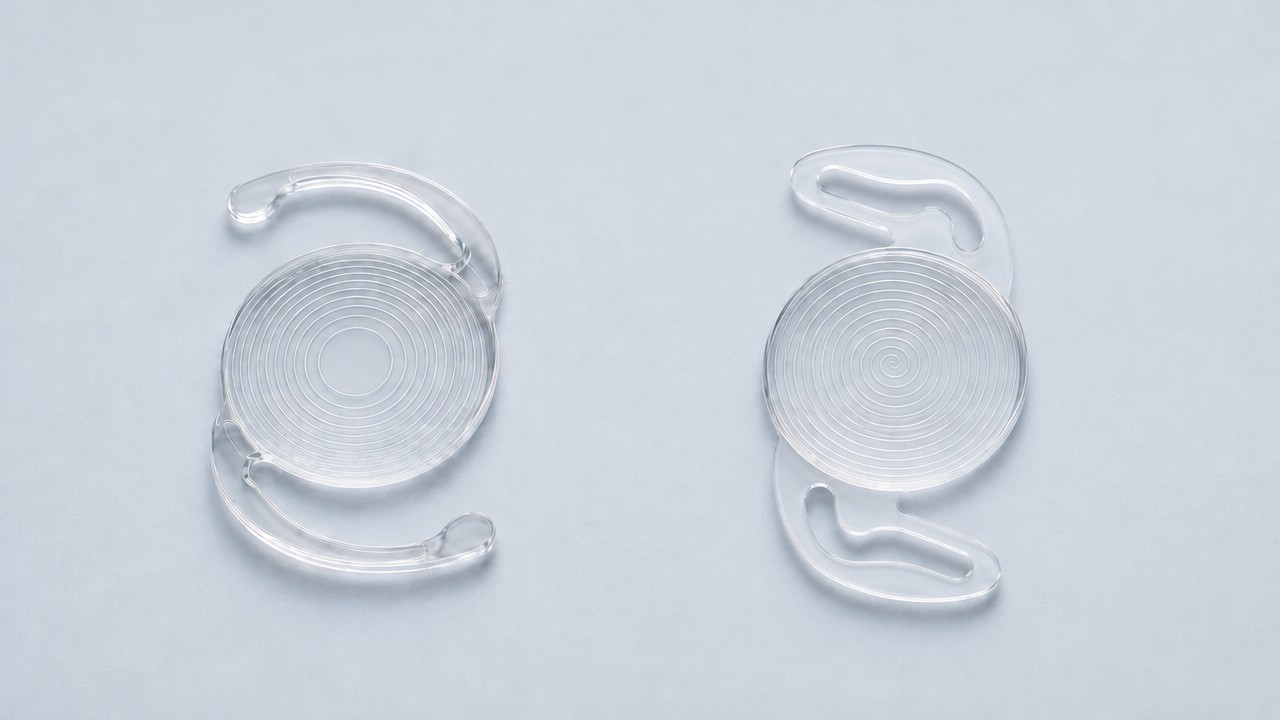
Figure 1. A ring lens (left) and a spiral lens (right). On the ring lens, every ring is a separate closed circle. On the spiral lens, one continuous groove winds gradually outward from the center, like the groove on a record. The grooves are drawn bolder than on a real lens so you can see them.
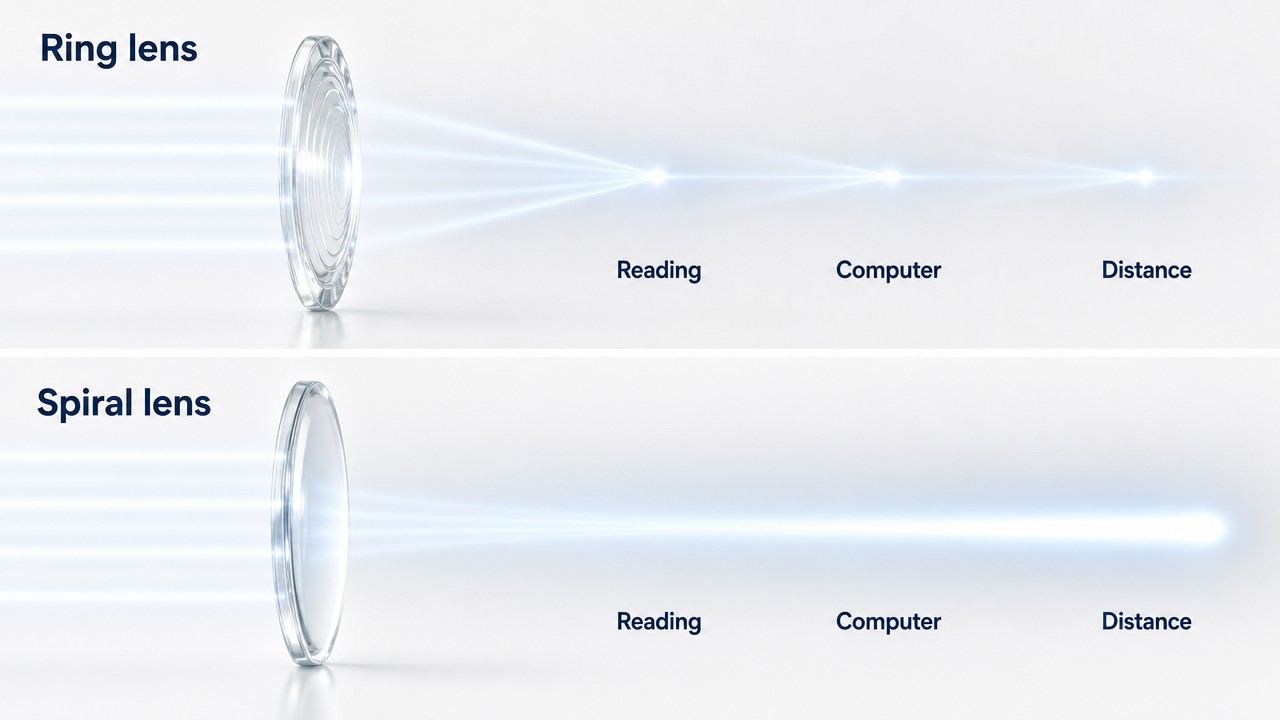
So how does it actually work? In plain terms, the Galaxy works like an extended depth of focus (EDOF) lens and partially like a multifocal lens. A 2026 laboratory study by Dr. Damien Gatinel's group measured the lens in detail and found that most of its range comes from a smooth, rotationally symmetric optical profile (spherical aberration). That is how an EDOF lens stretches focus. The spiral contributes a smaller share, and the FDA describes it as adding intermediate and near focusing power, which is how a multifocal lens works. None of this makes the lens less effective. It means the spiral is not the whole story.
The honest trade-off: more reading vision than a ring-free extended depth of focus lens, with more halos and a little less distance sharpness than a monofocal lens. Understanding that exchange is the most important part of choosing this lens. Our lens simulator lets you preview a daytime scene and a night driving scene through each lens category.
What Vision Can You Expect with the Galaxy?
The FDA trial randomized 230 patients at 10 U.S. centers to the Galaxy or to Rayner's own monofocal lens in both eyes, and followed them for four to six months. Examiners did not know which lens each patient had. Here is a realistic picture, assuming healthy eyes and both eyes implanted:
- Distance (driving, TV, golf): Good, but not as crisp as a monofocal lens. With both eyes open and no glasses, 92.7% of Galaxy patients saw 20/32 or better and 29.4% saw 20/20 or better. With a monofocal lens, 100% saw 20/32 or better and 68.8% saw 20/20 or better.
- Intermediate (computer, dashboard, cooking): Excellent. With both eyes open and no glasses, 79.8% of Galaxy patients saw 20/25 or better at computer distance, compared with 32.1% of monofocal lens patients.
- Near (phone, menus, books): Strong. With both eyes open and no glasses, 86.2% of Galaxy patients read 20/32 or better at 16 inches, compared with 11.9% of monofocal lens patients. Every Galaxy patient read 20/40 or better, compared with 38.5%.
- Would they do it again? 90.9% of Galaxy patients said they would choose the same lens again. So did 89.8% of monofocal lens patients.
| FDA trial result (4 to 6 months) | Eyes tested | Glasses worn for the test | Galaxy | Monofocal |
|---|---|---|---|---|
| Distance, average | One eye | Best distance glasses | about 20/21 | about 20/18 |
| Distance, average | Both eyes | Best distance glasses | about 20/19 | about 20/17 |
| Distance, 20/20 or better | One eye | Best distance glasses | 43.6% | 79.3% |
| Distance, 20/20 or better | Both eyes | None | 29.4% | 68.8% |
| Distance, 20/32 or better | Both eyes | None | 92.7% | 100% |
| Computer (66 cm), average | One eye | Distance glasses only | about 20/27 | about 20/43 |
| Computer (66 cm), average | Both eyes | Distance glasses only | about 20/23 | about 20/34 |
| Computer (66 cm), 20/25 or better | Both eyes | None | 79.8% | 32.1% |
| Reading (40 cm), average | One eye | Distance glasses only | about 20/36 | about 20/67 |
| Reading (40 cm), average | Both eyes | Distance glasses only | about 20/30 | about 20/53 |
| Reading (40 cm), 20/32 or better | Both eyes | None | 86.2% | 11.9% |
| Reading (40 cm), 20/40 or better | Both eyes | None | 100% | 38.5% |
Source: FDA Summary of Safety and Effectiveness, PMA P060011/S045. Eye-chart values are approximate conversions of the reported average scores. One-eye figures are for the first eye operated on. The summary does not report one-eye vision without glasses.
How to read this table. With glasses on to correct any leftover astigmatism and lens power error, the monofocal group saw better at distance: about 20/18 with one eye, compared with about 20/21 for the Galaxy group. Wearing those same distance glasses, the Galaxy group saw better at computer and reading distance. That is the lens adding range.
The trial did not test near vision through reading glasses. My expectation is that with reading glasses on, the monofocal group would read slightly better, for the same reason it saw slightly better at distance. So with the Galaxy you gain range of vision, and in exchange you accept slightly lower quality of vision and more halos.
One practical point from the laboratory studies: the Galaxy's near focus is strongest when the pupil is small. Expect the best reading vision in bright light, and expect that readers may still help for fine print in a dim restaurant.
The FDA summary does not report how many patients were completely free of glasses. Any specific "glasses free" percentage you see for the Galaxy comes from somewhere else.
Halos, Glare and Night Driving
This is the question I hear most, so here are the numbers rather than the slogan.
- At six months, 10.9% of Galaxy patients reported seeing halos "very often," compared with 0.9% of monofocal lens patients.
- Of the Galaxy patients who noticed halos, 82% said they were not bothersome or only a little bothersome.
- About 5.5% of all Galaxy patients were very bothered by halos.
- Glare, starbursts, blur and most other symptoms occurred at similar rates in both groups.
- In a second questionnaire, 26% of Galaxy patients reported trouble with night driving "often" or "always," compared with 16% of monofocal lens patients. The FDA cautions that this second questionnaire was not validated, so treat it as a direction, not a precise figure.
Contrast sensitivity, the ability to see faint shades of gray in dim light, met the FDA's standard: it was no more than 0.3 log units below the monofocal lens at every level tested. That means the loss stayed within an acceptable range. It does not mean contrast was identical.
My reading: the Galaxy appears gentler than many older multifocal lenses, and it is not the same as a monofocal lens at night. If you drive at night for a living, that matters.
The YAG Laser Finding
This is the result I discuss with every patient considering this lens. Within six months of surgery, 21.4% of Galaxy first eyes needed a YAG laser capsulotomy, compared with 7.0% of monofocal lens eyes. In second eyes the rates were 24.3% and 7.9%.
A YAG laser capsulotomy is a quick, painless office procedure that clears a hazy membrane behind the lens implant. It is not a reason to avoid the Galaxy. It is a reason to expect that a follow-up laser treatment is more likely, and sooner. Even mild haze is more noticeable through a lens that divides focus.
Overall complication rates were otherwise similar between the two groups. No eye in either group needed a second surgery because a patient could not tolerate the optics.
Who Is a Good Candidate?
Based on the evidence so far, the Galaxy tends to fit patients who:
- Want computer and reading vision without glasses for most daily tasks
- Are worried about halos with a ring-based trifocal, but want more reading vision than an extended depth of focus lens provides
- Accept slightly less crisp distance vision than a monofocal lens would give
- Are comfortable using readers occasionally for fine print in dim light
- Have healthy eyes: a clear cornea, a healthy macula and optic nerve, and a good tear film, or are willing to treat dry eye before surgery
- Have astigmatism within the toric range
Who Should Consider Something Else?
- You want the sharpest possible distance and night vision. A non-diffractive extended depth of focus lens such as PureSee or Vivity, or a monofocal lens, is usually the better match.
- You want the strongest reading vision available. On the FDA numbers, a ring-based trifocal such as PanOptix reads better than the Galaxy.
- You have glaucoma, macular degeneration or an irregular cornea. The Galaxy trial was designed to exclude eyes with significant disease of this kind. I am cautious with any lens that divides focus when a patient has moderate or advanced glaucoma or macular degeneration.
- You have had LASIK, PRK or radial keratotomy. The trial also excluded eyes with prior refractive surgery, so there is no trial evidence for the Galaxy in those eyes.
- Budget is the priority. Standard cataract surgery with a monofocal lens is covered by Medicare and most insurance. Mini-monovision with monofocal lenses is a covered way to gain some near vision.
How the Galaxy Compares to the Other 2026 Options
The side by side table is near the top of this article. Every eye-chart figure in the comparisons below was measured with both eyes open and distance glasses on, unless stated otherwise.
Galaxy vs. PureSee (Johnson & Johnson)
PureSee is a ring-free extended depth of focus lens built to keep distance and night vision close to a monofocal lens. On the FDA numbers, the Galaxy reads better (about 20/30 vs about 20/38) and the two are similar at computer distance. In a laboratory comparison, the two lenses produced a similar halo, and PureSee showed excellent distance quality. Reading power favors the Galaxy. Distance crispness and night driving favor PureSee.
Galaxy vs. Vivity (Alcon)
Vivity is the other ring-free extended depth of focus lens in the United States. Computer vision in each lens's trial was about 20/23. The Galaxy read better (about 20/30 vs about 20/36), and Vivity had the lowest rate of very bothersome halos in the table. If night vision is your first priority, Vivity or PureSee is the safer choice. If reading without glasses matters more, the Galaxy has the edge.
Galaxy vs. PanOptix, Envy and Odyssey (ring-based lenses)
Ring-based trifocals remain the strongest lenses for reading. PanOptix read about 20/22 in its trial, compared with about 20/30 for the Galaxy. The laboratory study found a smaller halo with the Galaxy than with PanOptix, but the patient questionnaires do not yet show a clear advantage, and the questionnaires were different. The honest answer is that we do not know yet. Comparable FDA figures for Envy and Odyssey were not available in the same format. See our Envy guide and our EDOF vs. multifocal comparison.
Galaxy vs. a monofocal lens
This is the one comparison tested head to head. With one eye tested and distance glasses on, the Galaxy gave almost three more lines of reading vision on the eye chart. In exchange, 20/20 distance vision with both eyes open and no glasses was less common (29.4% vs 68.8%), halos were more common, and a YAG laser treatment was about three times as likely within six months.
Galaxy vs. the Light Adjustable Lens (RxSight)
The Light Adjustable Lens takes a different approach: its power is fine-tuned with light treatments after surgery. That makes it the precision option for unusual eyes, such as those with prior LASIK or radial keratotomy. It offers a narrower range of vision than the Galaxy and requires several extra office visits. Range favors the Galaxy. Adjustability favors the Light Adjustable Lens.
Put simply, the Galaxy is a promising middle option: more reading power than an extended depth of focus lens, possibly with fewer halos than a trifocal. The study that would settle the question, a randomized trial against PanOptix, Odyssey, Envy or PureSee, has not been done. You can see these categories side by side in our Lens Simulator & Guide.
Does the Galaxy Correct Astigmatism?
Yes. The RayOne Galaxy Toric (model RAO615X) corrects roughly 1.0 to 3.0 diopters of corneal astigmatism in the same surgery. The non-toric Galaxy (model RAO605G) is for eyes with less than 1.0 diopter. One caveat: there was no separate clinical trial of the Galaxy Toric. The FDA approved it based on the Galaxy trial combined with an earlier trial of Rayner's toric lens platform. Read more about toric lenses.
What Does the Galaxy Lens Cost?
Medicare and most private insurance cover the standard portion of cataract surgery, which includes a quality monofocal lens. The Galaxy is a premium lens, so the upgrade portion is paid out of pocket, exactly like PanOptix, Odyssey, Envy or PureSee. Nationally, premium lens packages commonly add roughly $1,500 to $3,500 per eye beyond the covered portion. I have not set a price for the Galaxy because I am not offering it yet. For reference, our all-inclusive price for the TECNIS PureSee and the enVista Envy upgrade is $2,695 per eye. I will not recommend a premium lens unless I believe your eyes can deliver its benefits.
How I Help You Decide
At Eye MDs of Inland in Upland, California, every lens recommendation begins with measurements: corneal topography, optical biometry, a tear film evaluation, and imaging of the macula and optic nerve. Then we talk about how you live: how much you drive at night, how many hours you spend on a computer, and how you feel about readers. I am not implanting the Galaxy yet. It is brand new in the United States, and a lens that looks good in a six month trial still has to prove itself in everyday practice. I would rather see how it performs for other surgeons over the coming months than have my patients be the first to find out. If the real-world results hold up, I will add it. In the meantime, the lenses I implant today cover the same needs. Patients come to our Upland office from Rancho Cucamonga, Ontario, Claremont, Montclair, Chino, Pomona and Fontana.
The Galaxy is a new optical idea, and its FDA trial was well run: masked, randomized and transparent about its results. The data show a real gain in computer and reading vision, a modest cost in distance sharpness, halos that are mostly mild, and a higher chance of needing a YAG laser treatment. Until a head to head trial is done, I see it as a promising addition to the menu, not a replacement for the lenses we already trust. Try the lens simulator before your visit, and bring your questions.
Works Cited
1. U.S. Food and Drug Administration. Summary of Safety and Effectiveness Data: RayOne Galaxy and RayOne Galaxy Toric (PMA P060011/S045). Approved September 24, 2026.
2. Abela-Formanek C, Amon M, Auffarth GU, et al. Performance of the first spiral refractive intraocular lens for continuous full range of vision. Journal of Refractive Surgery. 2025;41(11):e1213-e1222.
3. Arias Puente A, Carrero Collantes A, Rincón Rosales JL, Infiesta-Valderrey L, Piñero DP. Clinical outcomes of a new presbyopia-correcting intraocular lens with spiral optic. Graefe's Archive for Clinical and Experimental Ophthalmology. Published online September 19, 2026.
4. Tommasi F, Giorgetti A, Gurioli M, Mariñas-Garcia L, Cavalieri S, Ruiz-Alcocer J. Optical performance of a novel non-diffractive presbyopia-correcting intraocular lens as a function of defocus and pupil size. Journal of Refractive Surgery. 2026;42(7):e701-e709.
5. Gatinel D, Entin A, Stern B. In vitro optical characterization of the RayOne Galaxy spiral EDOF IOL using high-resolution Mach-Zehnder interferometry. Biomedical Optics Express. 2026;17(7):3984-4001.
6. Kim DH, Son HS, Wu Z, Auffarth GU, Łabuz G. Estimating range of vision and optical function related to pupil size in a spiral intraocular lens. Journal of Refractive Surgery. 2026;42(6):e514-e521.
7. U.S. Food and Drug Administration. Summaries of Safety and Effectiveness Data for AcrySof IQ PanOptix (P040020/S087, 2019), AcrySof IQ Vivity (P930014/S126, 2020) and TECNIS PureSee (P980040/S176, 2026).
8. Rayner. Rayner announces FDA approval of Galaxy, the world's first spiral IOL. Press release, September 24, 2026.
