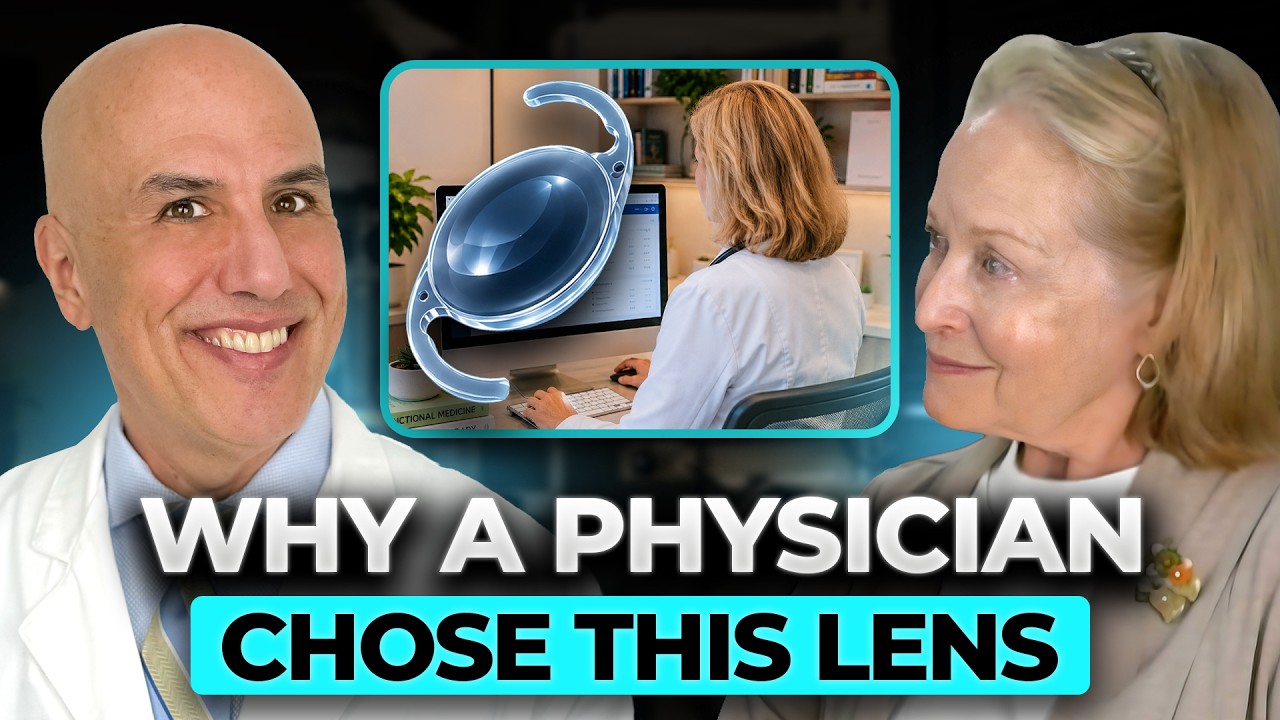
On March 12, 2026, the FDA approved the Johnson & Johnson TECNIS PureSee™ intraocular lens for cataract surgery in the United States. It is one of the most anticipated lens approvals in years, and for good reason: PureSee is the first FDA approved extended depth of focus (EDOF) lens shown to maintain contrast sensitivity comparable to a standard monofocal lens. In plain terms, it stretches your range of clear vision without the rings, and without the ring related side effects, that patients have long associated with premium lenses.
As cataract surgeons, we get asked about new lens technology every week. This guide explains what the PureSee lens actually is, how it differs from every other option in 2026, what vision you can realistically expect, who is a good candidate, who is not, and what it costs. If you want the short first look we published when the approval was announced, read our original PureSee article. This is the deep dive.
What Is the TECNIS PureSee IOL?
During cataract surgery, your cloudy natural lens is removed and replaced with a clear artificial lens implant, called an intraocular lens or IOL. The lens you choose determines how you will see for the rest of your life, which is why we consider this a once in a lifetime vision decision.
PureSee is Johnson & Johnson’s newest extended depth of focus (EDOF) lens. Instead of giving you a single point of sharp focus the way a basic monofocal lens does, an EDOF lens stretches that focus into a continuous range, so distance and intermediate vision (computer, dashboard, countertop) stay clear together.
What makes PureSee different is how it stretches the focus:
- It is purely refractive. The lens surface uses a smooth, continuous change in curvature (a refractive power gradient) to extend focus. There are no diffractive rings etched into the optic.
- It does not split light. Diffractive lenses divide incoming light among two or three separate focal points. PureSee bends all of the light through one continuous, elongated focus instead.
- It preserves contrast. In the FDA clinical study, contrast sensitivity showed no clinically meaningful difference from a standard aspheric monofocal lens across pupil sizes. That is a claim no diffractive presbyopia correcting lens can make.
- It comes in toric versions. PureSee Toric II lenses correct astigmatism at the same time, so patients with astigmatism are not excluded.
Although it is new to the United States, PureSee is not experimental. It has been used internationally since 2024, with roughly half a million eyes implanted worldwide before the FDA approval.
Rings vs. No Rings: Why the Design Matters
Most premium lenses that deliver a fuller range of vision, including trifocals like PanOptix® and Envy® and diffractive EDOF lenses like Symfony® and Odyssey™, use microscopic concentric rings on the lens surface. The rings work, and they deliver the strongest reading vision available. But splitting light has a price. Some patients notice:
- Halos around headlights and streetlights at night
- Glare or starburst patterns
- A mild reduction in contrast, especially in dim light
Most people adapt well, and modern diffractive lenses are far better than early generations. But for patients who drive at night frequently, or whose eyes are less forgiving of contrast loss, those trade-offs matter.
The PureSee design flips the bargain. By using a smooth refractive surface with no rings, it delivers:
- A dysphotopsia profile (halos, glare, starbursts) comparable to a basic monofocal lens in published studies
- Monofocal-like contrast and crispness
- Clear distance plus strong intermediate vision
The honest trade-off: less near magnification than a trifocal. PureSee gives functional near vision, not the powerful reading vision of a ring based lens. You get cleaner night vision in exchange for keeping a pair of reading glasses nearby for fine print. Understanding that exchange is the single most important part of choosing between these lenses.
What Vision Can You Expect with PureSee?
Based on the FDA clinical study and published peer reviewed data, here is a realistic picture, assuming healthy eyes and both eyes implanted:
- Distance (driving, TV, golf): Excellent. Distance clarity in studies matched standard monofocal lenses, with average uncorrected binocular vision around 20/20.
- Intermediate (computer, dashboard, cooking): Strong. Most patients see around 20/25 at arm’s length without glasses.
- Near (phone, menus, price tags): Functional. In the FDA study, near vision averaged about a line and a half better than a standard monofocal lens. Most patients handle a phone screen or a menu in good light, but many still prefer readers for small print or long reading sessions.
- Night vision: This is the headline. In clinical data, 97% of patients reported no very bothersome halos or glare, and 97% said they would recommend the lens to friends or family.
One more practical advantage from the published research: PureSee is relatively forgiving. Its optics stay stable across different pupil sizes, and studies show it tolerates small amounts of residual prescription error better than many premium designs. Real eyes are not perfect, so forgiveness is a genuinely useful trait in a lens.
Who Is a Good Candidate?
We think PureSee will be one of the most frequently chosen premium lenses in our practice. It tends to fit patients who:
- Want sharp distance vision and glasses free computer and dashboard vision
- Drive at night regularly and want to minimize halo and glare risk
- Value contrast and image quality over maximum reading power
- Are comfortable using reading glasses occasionally for fine print
- Have astigmatism (the Toric II version corrects it in the same surgery)
A note for patients with glaucoma or early macular changes. Surgeons have traditionally avoided diffractive multifocal lenses in eyes with glaucoma or macular degeneration, because those conditions already reduce contrast sensitivity, and a light splitting lens reduces it further. Because PureSee preserves contrast like a monofocal, it may reasonably be considered in select patients with mild, well controlled glaucoma or mild early macular changes who still want an extended range of vision. This is an individualized judgment call that depends on the severity and stability of your condition. In moderate or advanced disease, a monofocal lens usually remains the safer choice. This is exactly the kind of decision to make together with your surgeon after a full examination.
Who Should Consider Something Else?
- You want the strongest possible reading vision without glasses. A trifocal such as PanOptix Pro or Envy, or the diffractive Odyssey lens, will deliver more near power. Read our comparison of the best premium cataract lenses in 2026.
- Your eye health is significantly compromised. Advanced macular degeneration, significant corneal irregularity, or unstable eye disease usually points toward a monofocal lens chosen for maximum image quality.
- Budget is the priority. Standard cataract surgery with a monofocal lens is covered by Medicare and most insurance and produces excellent distance vision with glasses for near tasks.
How PureSee Compares to the Other 2026 Options
PureSee vs. Vivity (Alcon)
Vivity is the other non diffractive EDOF lens in the United States and has been available for several years. Both avoid rings and both have low halo and glare rates. Head to head studies show comparable distance and near vision; Vivity has shown a modest edge at some intermediate distances, while PureSee’s optics are more stable across pupil sizes and it carries the FDA labeling on monofocal-like contrast. These two lenses compete directly, and the choice often comes down to your measurements and your surgeon’s assessment of your eyes.
PureSee vs. Symfony and Odyssey (Johnson & Johnson)
Symfony was J&J’s original diffractive EDOF lens, and Odyssey is its newest full range diffractive lens. Both use ring based optics: more reading power, more potential for nighttime halos. A published comparison found the PureSee design produced a lower rate of photic phenomena than the diffractive Symfony. Odyssey is the J&J option for patients who prioritize strong near vision; PureSee is the J&J option for patients who prioritize visual quality and night driving.
PureSee vs. PanOptix Pro and Envy (trifocals)
Trifocal lenses remain the champions of spectacle independence, with roughly 90% of patients functioning without glasses at all distances. They are the right call for many motivated patients with healthy eyes. The cost is ring based optics: a higher chance of halos and some contrast reduction. PureSee will not match their reading power; they will not match its night vision profile.
PureSee vs. Eyhance (enhanced monofocal)
Eyhance is J&J’s enhanced monofocal: covered like a standard lens in many billing scenarios, with a small intermediate boost. Studies comparing the two show PureSee provides meaningfully better intermediate and near vision, with similar distance vision and similar side effect profiles. Think of Eyhance as a modest upgrade and PureSee as the full EDOF experience.
PureSee vs. the Light Adjustable Lens (RxSight)
The Light Adjustable Lens (LAL) takes a completely different approach: its power is fine tuned with ultraviolet light treatments after surgery, which makes it the precision option for unusual eyes, such as those with prior LASIK or radial keratotomy. It offers excellent image quality but a narrower range of vision than PureSee, and it requires several office visits for light treatments plus UV protective glasses during the adjustment period. Range and simplicity favor PureSee; adjustability favors the LAL.
What Does the PureSee Lens Cost?
Medicare and most private insurance cover the standard portion of cataract surgery, which includes a quality monofocal lens. PureSee is a presbyopia correcting premium lens, so the upgrade portion is paid out of pocket, exactly like other premium lenses. Nationally, premium lens packages commonly add roughly $1,500 to $3,500 per eye beyond the covered portion, depending on the practice, the technology included, and whether astigmatism correction is bundled. At Eye MDs of Inland, our all-inclusive price for the TECNIS PureSee upgrade is $2,695 per eye, the same as for the enVista Envy. We confirm the exact figure for your eyes at your consultation, and we will never recommend a premium lens unless we believe your eyes can actually deliver its benefits.
How We Help You Decide
At Eye MDs of Inland in Upland, every lens recommendation starts with measurements, not marketing: corneal topography, optical biometry, a careful look at your ocular surface, and imaging of your macula and optic nerve. Then we talk about how you actually live: how much you drive at night, how many hours you spend on a computer, how you feel about reading glasses. Our premium cataract surgery page explains the technology we use, and our interactive lens simulator lets you preview the trade-offs for yourself before your visit.
The PureSee lens is a genuinely important addition to the 2026 lineup: for the large group of patients who want a wider range of vision without gambling on night time side effects, it may be the most sensible premium choice yet. Whether it is right for your eyes is a question we would be glad to answer in person.
Related reading: The RayOne Galaxy spiral IOL: what the FDA trial and published studies show. The FDA approved this new spiral lens implant in September 2026.
Works Cited
1. Johnson & Johnson. Johnson & Johnson Announces FDA Approval of TECNIS PureSee Intraocular Lens. Press release, March 12, 2026.
2. Healio Ocular Surgery News. FDA approves Johnson & Johnson’s Tecnis PureSee IOL. March 2026.
3. Quality of vision clinical outcomes for a new fully-refractive extended depth of focus intraocular lens. Eye (2024).
4. Tolerance to refractive error with a new extended depth of focus intraocular lens. Eye (2024).
5. Optical and Visual Outcomes of a New Refractive Extended Depth of Focus Intraocular Lens. Journal of Refractive Surgery (2025).
6. Comparative Visual Performance of Two Non-Diffractive Extended Depth-of-Focus Intraocular Lenses: TECNIS PureSee versus Clareon Vivity. Clinical Ophthalmology (2025).
7. Evaluation of Clareon Vivity and PureSee intraocular lenses: optical quality, depth of focus and misalignment effects. Scientific Reports (2025).
8. Comparative Outcomes of the Next-Generation Extended Depth-of-Focus Intraocular Lens and Enhanced Monofocal Intraocular Lens in Cataract Surgery. PubMed Central (2025).