
Two families of premium lens implants promise to reduce your need for glasses after cataract surgery: extended depth of focus (EDOF) lenses and multifocal lenses (today, mostly trifocals). Patients often assume they are two brands of the same thing. They are not. They are built differently, they produce different kinds of vision, and the research shows they trade strengths in a very predictable way.
This article walks through the difference in design, then the difference in results: distance, computer and reading vision, glasses independence, and the night vision side effects that matter most to the patients I see. I have kept the numbers to what published, peer-reviewed comparisons actually show.

The Design Difference: Stretching Light vs. Splitting Light
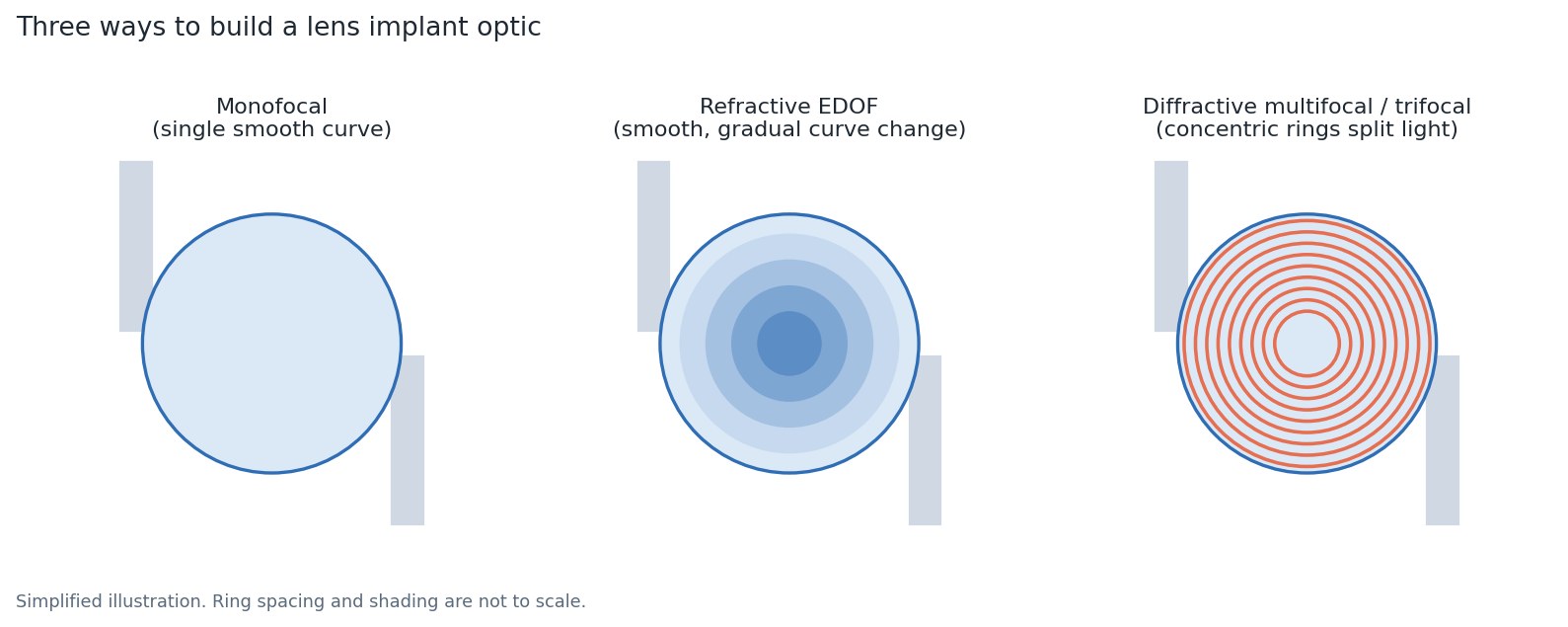
A standard monofocal lens has one focal point. Everything at that distance is sharp, and clarity falls off steadily as objects move closer.
A multifocal or trifocal lens uses microscopic concentric rings (a diffractive design) to split incoming light into two or three separate focal points: distance, intermediate and near. Each focal point gets a share of the light. Examples available in the United States include PanOptix and PanOptix Pro (Alcon), enVista Envy (Bausch + Lomb), and Odyssey (Johnson & Johnson).
An extended depth of focus lens takes a different approach. Instead of separate focal points, it stretches a single focus into a longer, continuous zone. Some EDOF lenses do this with a smooth, non-diffractive surface (Vivity from Alcon and TECNIS PureSee from Johnson & Johnson). The older Symfony lens used a diffractive EDOF design. You can compare all three designs side by side in our Lens Simulator & Guide (opens in a new tab).
What That Means for the Range of Vision
Surgeons compare lenses with a defocus curve: a graph of how sharp vision stays as an object moves from far away to close up. The shapes tell the story.
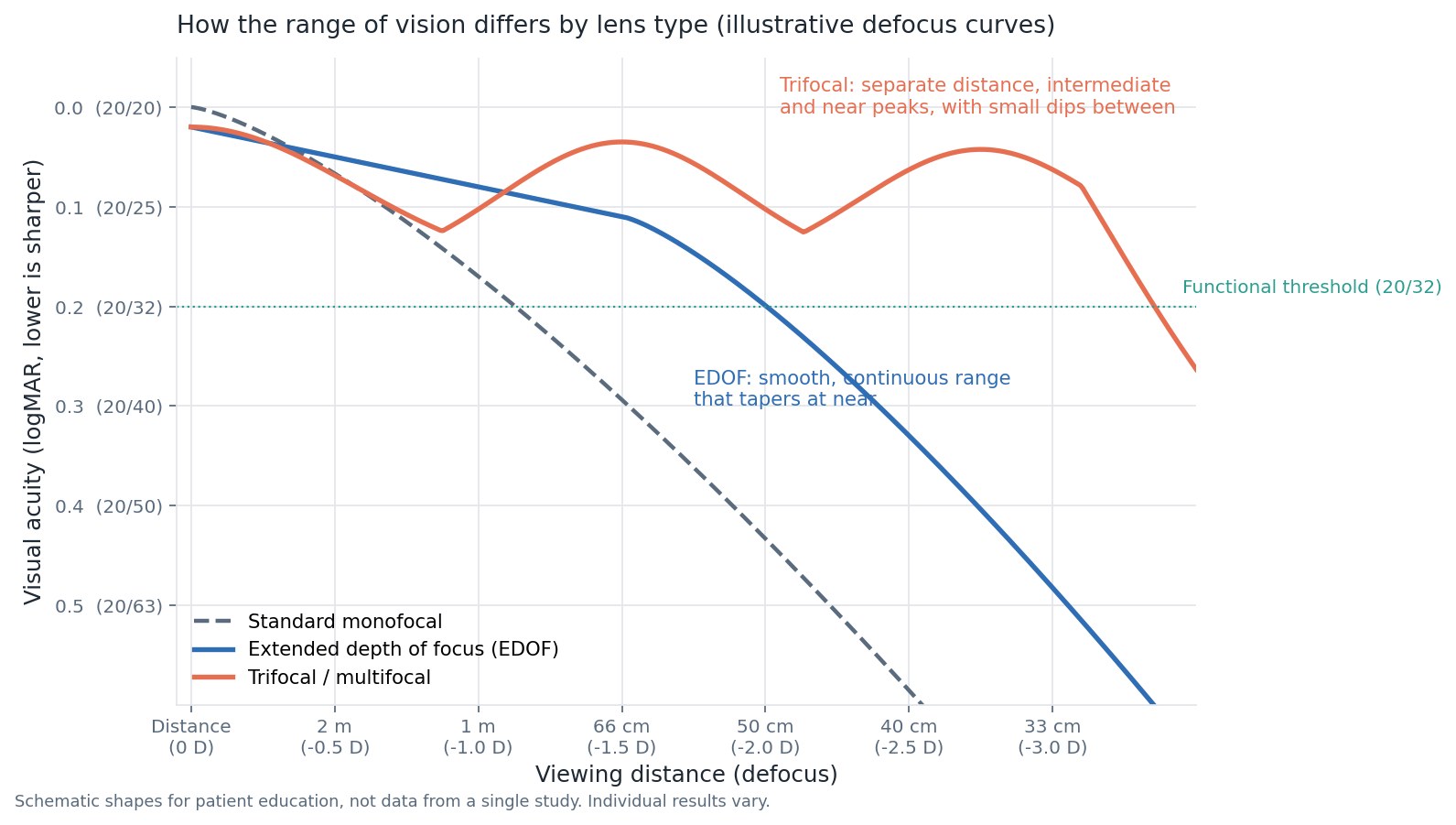
- Distance: essentially the same. Every major review finds no meaningful difference in uncorrected distance vision between EDOF and multifocal lenses.
- Intermediate (computer, dashboard, cooking): both are good. A 2021 meta-analysis of 13 studies (898 trifocal eyes and 624 EDOF eyes) found a small but statistically significant edge for EDOF at intermediate distance.
- Near (phone, menus, books): this is where they separate. In the same meta-analysis, trifocal lenses delivered clearly better uncorrected near vision, about a line and a half on the eye chart. In one randomized study included in the 2024 Cochrane review, only 3% of trifocal patients had near vision worse than J2 (roughly newspaper print), compared with 30% of patients with the diffractive EDOF lens studied.
To see these curves as actual pictures rather than graphs, switch the lens type in the Lens Simulator and watch how the near text and the distant road sign change.
Glasses Independence: The Numbers
Because near vision is the difference, near spectacle independence is where multifocals win on paper. The 2021 meta-analysis found that trifocal patients were about 10% more likely to be free of glasses for near tasks than EDOF patients. The 2024 Cochrane review, which used stricter criteria, concluded that trifocal patients "may be less dependent on spectacles for near vision," while questionnaires in the two studies that measured overall spectacle independence showed no clear winner.
A 2025 overview of eight systematic reviews in the British Journal of Ophthalmology summarized the field this way: multifocal and EDOF lenses perform comparably for distance and intermediate vision, multifocals perform better for near vision "but at the cost of glare and halos," and EDOF lenses may offer excellent spectacle independence overall without consistently matching multifocals at near.
In plain terms: if reading small print without any glasses is the single thing you care most about, a trifocal is more likely to get you there. If you would happily keep a pair of readers in the kitchen drawer in exchange for cleaner vision the rest of the day, EDOF is designed for you.
Halos, Glare and Contrast: The Trade-Off
Splitting light has a cost. When several focal points exist at once, the out-of-focus images create rings around point sources of light, which patients experience as halos around headlights and streetlights. The 2021 meta-analysis found halos were reported about 32% more often with trifocal lenses than with EDOF lenses (glare rates were similar). Smaller randomized studies in the Cochrane review were too small to detect a difference either way, which is worth knowing: the gap is real, but it is not enormous, and modern trifocals are far better than early multifocals.
Contrast sensitivity, the ability to see subtle shades of gray in dim light, is the other consideration. Diffractive lenses of both types reduce contrast slightly. The newest non-diffractive EDOF lenses change that calculation: in its FDA study, TECNIS PureSee showed no clinically meaningful difference in contrast sensitivity from a standard monofocal lens, and 97% of patients reported no very bothersome halos or glare. That is why we increasingly consider non-diffractive EDOF lenses for patients with mild glaucoma or early macular changes, where any loss of contrast matters more.
Do not take a dark image of trifocals from this, though. Roughly 90% of trifocal patients function without glasses at all distances, and most adapt to halos within months through a process called neuroadaptation. The right question is not "which lens is better" but "which trade-off is better for me." The night driving scene in our Lens Simulator shows what the halo trade-off actually looks like.
A Simple Way to Choose
| If this describes you | Lean toward |
|---|---|
| You want to read a paperback and a pill bottle with no glasses, ever | Trifocal (PanOptix Pro, Envy, Odyssey) |
| You drive at night often, or halos would bother you | Non-diffractive EDOF (PureSee, Vivity) |
| Most of your day is distance and computer, and readers are acceptable for fine print | EDOF, often with mild mini-monovision |
| You have mild glaucoma, early macular degeneration or a less-than-perfect ocular surface | Non-diffractive EDOF or monofocal; avoid diffractive rings |
| You want the best of both | Ask about "mix and match": a trifocal in one eye and an EDOF in the other |
That last option deserves a note. A 2026 meta-analysis of five studies (225 patients) found that a trifocal in one eye plus an EDOF in the fellow eye produced average binocular vision of about 20/22 at distance, 20/21 at intermediate and 20/25 at near. The evidence is still early and the studies were small, but for the right patient it is a thoughtful compromise.
The best way to feel these trade-offs before you commit is to see them. Our interactive Lens Simulator & Guide lets you switch between monofocal, EDOF and multifocal designs on a daytime scene and a night driving scene, with and without astigmatism correction, so the words "halo" and "reading distance" become something you can actually look at.
Free app: the Cataract Surgery Guide for iPhone and Android
The same two-eye lens simulator, a plain-language guide to every lens type, what to expect on surgery day, and optional eye drop reminders are all in our free Cataract Surgery Guide app. It is completely free, requires no account, and collects no personal information.
How We Decide Together
At Eye MDs of Inland, every premium lens recommendation starts with measurements: corneal topography, optical biometry, a careful look at your tear film, and imaging of the macula and optic nerve. Some eyes simply should not receive a diffractive lens, and we would rather tell you that before surgery than after. Then we talk about your day: how much night driving, how much screen time, how you feel about readers. Our premium cataract surgery page describes the technology we use, and our ranking of the best premium lenses in 2026 compares the individual models. For the two lenses we are asked about most, our all-inclusive price for the TECNIS PureSee and the enVista Envy upgrade is $2,695 per eye.
Related reading: The RayOne Galaxy spiral IOL: what the FDA trial and published studies show. The FDA approved this new spiral lens implant in September 2026.
Related reading: Less need for glasses without extra halos: mini-monovision with EDOF lenses, a closer look at pairing a small offset with PureSee or Vivity.
Works Cited
1. Yao K, et al. Comparison of trifocal or hybrid multifocal-extended depth of focus intraocular lenses: a systematic review and meta-analysis. Scientific Reports. 2021.
2. Tavassoli S, Ziaei H, Yadegarfar ME, et al. Trifocal versus extended depth of focus (EDOF) intraocular lenses after cataract extraction. Cochrane Database of Systematic Reviews. 2024;7:CD014891.
3. Daka Q, Henein C, Fang CEH, et al. Effectiveness of intraocular lenses designed to correct presbyopia after cataract surgery: an overview of systematic reviews. British Journal of Ophthalmology. 2025;109(12):1323-1329.
4. Rakhimova M, et al. Visual outcomes after mix-and-match implantation of trifocal and extended depth-of-focus intraocular lenses: a systematic review and meta-analysis. Medicina. 2026;62(6).
5. Johnson & Johnson. Johnson & Johnson announces FDA approval of TECNIS PureSee intraocular lens. Press release, March 12, 2026.
