
If you have started researching cataract surgery, you have probably run into the word monovision, and maybe its younger cousin, mini-monovision. Both describe the same basic idea: setting one eye for distance and the other eye slightly closer, so that together your two eyes cover more range than either could alone. The difference between them is the size of the gap between the eyes, and that difference changes almost everything about how the result feels.
I use mini-monovision every week with patients who want less dependence on reading glasses but are not candidates for, or are not interested in, a premium multifocal lens. This article explains how it works, how it differs from traditional monovision, what the research says about spectacle independence, and how to decide whether it fits your eyes and your life.

First, a Quick Refresher on the Lens Implant Decision
During cataract surgery, the cloudy natural lens is removed and replaced with a clear artificial lens implant, called an intraocular lens (IOL). Because the implant has a fixed power, your surgeon chooses a refractive target for each eye before surgery: the distance at which that eye will be sharpest without glasses.
The most common plan is to target both eyes for distance. That gives crisp far vision for driving and television, with reading glasses for the phone, menus and books. Monovision and mini-monovision are alternatives that use the same standard monofocal lens (or an enhanced monofocal or extended depth of focus lens), but aim the two eyes at different distances on purpose. If you want to see what that looks like before reading further, our Lens Simulator & Guide (opens in a new tab) lets you set a different target for each eye.
Traditional Monovision: A Large Gap Between the Eyes
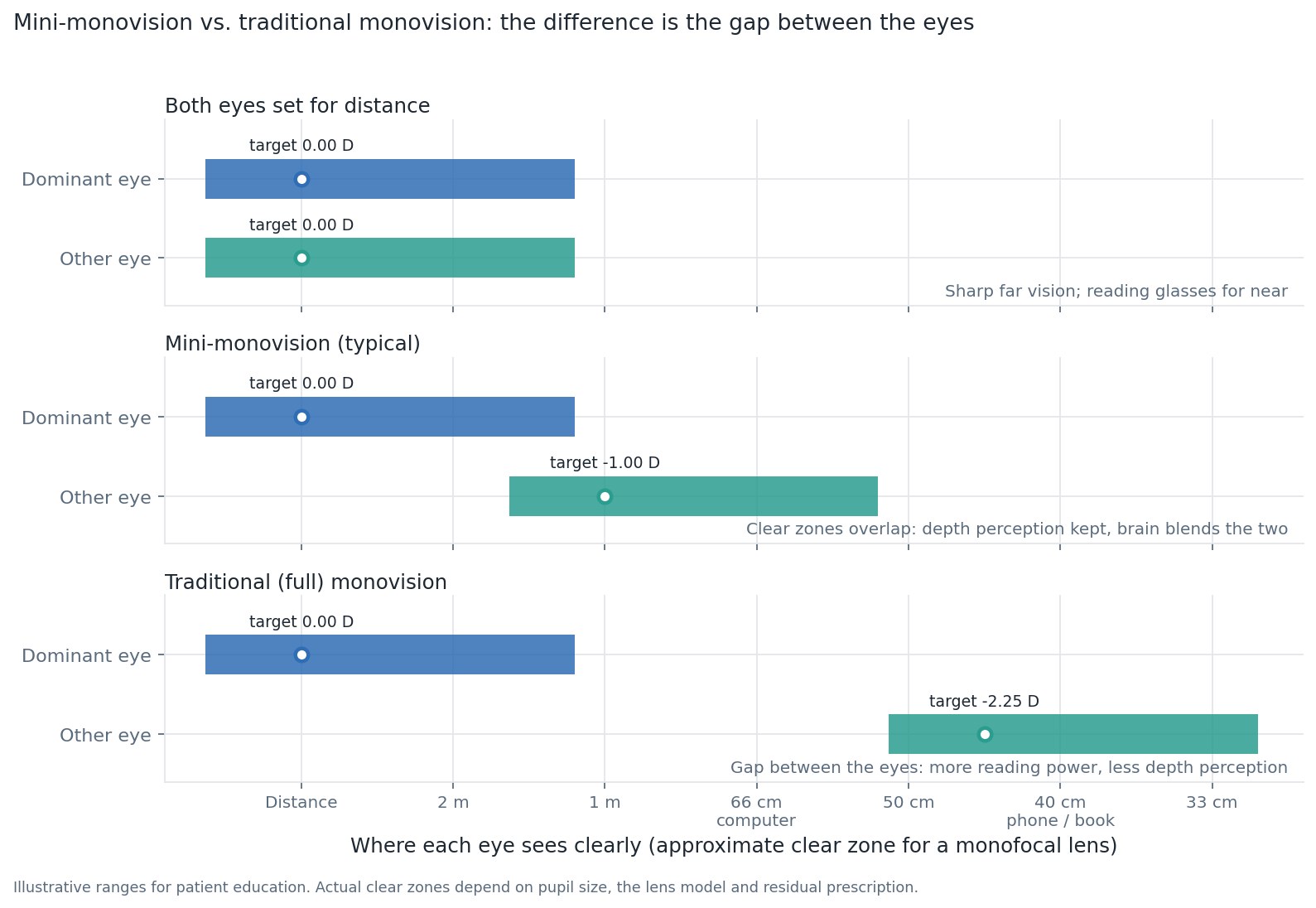
Traditional, or full, monovision came from the contact lens world decades ago. The dominant eye is set for distance and the other eye is set noticeably nearsighted, typically between -1.75 and -2.50 diopters. In practical terms, that second eye is focused around 40 to 55 centimeters (16 to 22 inches), which is book and phone distance.
The upside is real reading power without glasses. The downside is that the two eyes are now seeing very different pictures. Some people adapt beautifully. Others notice:
- Reduced depth perception (stereopsis). Your brain builds 3D vision by comparing two similar images. When one image is blurry, that comparison weakens, which can matter for stairs, curbs, pouring coffee, tennis or golf.
- A sense of imbalance. Some patients describe feeling "off," especially at first, or when they are tired.
- Weaker night driving. The near eye contributes blur and sometimes ghosting around lights at night.
- A gap in the middle. The distance eye and the near eye may both struggle at arm's length, which is exactly where the computer and dashboard live.
Mini-Monovision: A Small, Deliberate Gap
Mini-monovision keeps the same concept but shrinks the difference between the eyes. The dominant eye is set for distance and the other eye is set only mildly nearsighted, usually between -0.75 and -1.50 diopters. A 2026 review in Survey of Ophthalmology defines mini-monovision by exactly that range, and points out that the milder difference "better preserves stereopsis and binocular vision" compared with conventional monovision.
Why does such a small change matter so much? Because at -1.00 diopter the second eye is focused around one meter, and its zone of acceptable clarity still overlaps the distance eye's zone. Your brain is not being asked to choose between two very different images; it is being asked to blend two similar images, one of which reaches a little further in. The result feels like one continuous range of vision rather than a "near eye" and a "far eye."
Tip: the two-eye Lens Simulator has a refractive target control for each eye. Set the second eye to -1.00 D, then to -2.25 D, and compare the daytime and night driving scenes.
Mini-Monovision vs. Monovision: Side by Side
| Feature | Mini-monovision | Traditional monovision |
|---|---|---|
| Difference between eyes | About 0.75 to 1.50 D | About 1.75 to 2.50 D or more |
| Where the second eye focuses | Roughly 65 cm to 1.3 m (computer, dashboard, countertop) | Roughly 40 to 55 cm (book, phone) |
| Depth perception | Largely preserved | Measurably reduced |
| Adaptation | Usually quick and comfortable | Variable; some patients never adapt |
| Small print without glasses | Sometimes; readers often still used for long reading | More often, at the cost of balance |
| Night driving | Minimal effect | Can be noticeably affected |
| Insurance | Works with a standard, covered monofocal lens | Works with a standard, covered monofocal lens |
What the Research Says About Glasses Independence
The honest answer is: mini-monovision gets many patients most of the way to glasses freedom, not all the way. A 2025 systematic review in Frontiers in Medicine pooled 19 studies and 1,530 patients who had mini-monovision with three kinds of lenses. The average rate of complete spectacle independence was 51% with standard monofocal lenses, 55% with enhanced monofocal lenses, and 63% with extended depth of focus (EDOF) lenses. The differences between lens types were not statistically significant, and satisfaction was high in every group. Complications, lens exchanges and laser touch-ups were all rare.
Individual studies can look even better when the target is chosen carefully. In a Korean study of 50 patients receiving an enhanced monofocal lens (TECNIS Eyhance), the non-dominant eye was targeted at just -0.75 diopter. Only 20% of the mini-monovision patients reported needing glasses for near activities, compared with 80% of patients whose eyes were both set for distance. More than 90% were satisfied and every patient said they would recommend the approach.
A 2025 European study asked patients about specific tasks six months after surgery, comparing micro-monovision (about -0.5 to -0.75 D), mini-monovision (-1.0 to -1.5 D) and full monovision (-1.75 to -2.5 D). Computer work without glasses was common in every group, but reading a smartphone without glasses climbed as the gap widened. The lesson: the exact target is a dial, not a switch, and it should be set for your priorities.
Who Is a Good Candidate for Mini-Monovision?
- You want fewer reaches for reading glasses, but a premium lens is not right for you because of budget, eye health or preference.
- Your eyes are otherwise healthy. Mini-monovision works with a plain monofocal lens, so it is an option for many patients with mild glaucoma or early macular degeneration who are steered away from ring-based multifocal lenses.
- You have astigmatism. A toric monofocal lens can correct astigmatism and still be targeted for mini-monovision.
- You have worn monovision contact lenses before and liked it. That is the single best predictor of success.
Patients who usually do better with both eyes set for distance, or with a different plan, include pilots and others whose work depends on maximum stereopsis, people with significant amblyopia (a lazy eye) or strabismus (eye misalignment), and anyone who has tried monovision contacts and disliked it.
How We Test It Before Surgery
Because the target is set at the time of surgery, we like to preview it first. Before scheduling, we can simulate mini-monovision in the exam lane with trial lenses, or fit a contact lens in the planned near eye for a few days if the cataract still allows useful vision. We also measure which eye is dominant, because setting the non-dominant eye for near is usually more comfortable.
You can also preview the concept at home. Our interactive Lens Simulator & Guide lets you set a different refractive target for each eye and see how a daytime scene and a night driving scene change. It is the same simulator we use in the office when we talk through these choices.
Free app: the Cataract Surgery Guide for iPhone and Android
Everything on this page, plus the two-eye lens simulator, a plain-language review of every lens option, what to expect on surgery day, and optional eye drop reminders, is in our free Cataract Surgery Guide app. It is completely free, it does not ask you to create an account, and it collects no personal information.
Mini-Monovision With Premium Lenses
Mini-monovision is not only for basic lenses. Surgeons increasingly combine a small offset with extended depth of focus lenses such as TECNIS PureSee or Vivity, because those lenses already stretch each eye's range and a small nudge in one eye can close the remaining gap at near without the halos of a diffractive lens. A 2025 review in Clinical Ophthalmology argues that a single "plano for both eyes" target is often not ideal for modern lenses, and that customized planning that includes mini-monovision can improve results. Our EDOF vs. multifocal comparison covers those lenses in detail.
The Bottom Line
Traditional monovision buys reading vision by asking your brain to ignore one eye at a time. Mini-monovision asks much less of your brain: it keeps the eyes working together, protects depth perception and night driving, and still delivers a meaningful reduction in reading glasses for many patients, all with a standard lens that insurance covers. Try it yourself in the Lens Simulator before your visit, and bring your questions. It is one of the most underused tools in cataract surgery, and one I discuss with nearly every patient who tells me they would love to need their readers a little less.
Related reading: Less need for glasses without extra halos: mini-monovision with EDOF lenses, a closer look at pairing a small offset with PureSee or Vivity.
Works Cited
1. Kang S, Hsu J, Yoo SH. Pseudophakic mini-monovision. Survey of Ophthalmology. 2026;71(3).
2. Levy I, Shah RP, Mukhija R, Nanavaty MA. Outcomes of mini-monovision with monofocal, enhanced monofocal and extended depth-of-focus intraocular lenses. Frontiers in Medicine. 2025;12:1522383.
3. Park J, et al. Visual outcomes, spectacle independence, and patient satisfaction of pseudophakic mini-monovision using a new monofocal intraocular lens. Scientific Reports. 2022.
4. Iselin et al. Patient-reported outcome measures for assessing spectacle independence after implantation of monofocal or extended depth of focus intraocular lenses with various degrees of monovision. Klinische Monatsblätter für Augenheilkunde. 2025.
5. Skrzypecki J, Przybek-Skrzypecka J. Impact of intraocular lens design on refractive endpoint selection: a call for a new paradigm. Clinical Ophthalmology. 2025;19:4325-4334.
