
Almost every week a patient tells me some version of the same thing: "I would love to stop reaching for my reading glasses, but I drive at night and I do not want halos." For years the honest answer was that you had to pick. A multifocal lens implant could free you from readers, but it did so by splitting light, and split light makes rings around headlights. A standard lens kept the night clean, but you lived in reading glasses.
That trade-off is no longer as rigid as it was. The combination I now use most often for patients who want both is mini-monovision with an extended depth of focus (EDOF) lens. It meaningfully reduces how often you need glasses, and in the published studies its halo and glare profile is about the same as a standard monofocal lens. This article explains how it works, what the research shows, and why it is a very different proposition from the old-fashioned monovision many patients have heard about and rightly fear.
Why Halos Happen in the First Place
A halo is not a mystery. It is the out-of-focus image of a bright point of light landing on your retina at the same time as the in-focus image. A trifocal lens such as PanOptix uses microscopic concentric rings to send light to three separate focal points at once. Whichever focal point you are using, the other two are producing blur, and at night that blur appears as rings around headlights and streetlights. Most people adapt to it over months, but it is built into the optics and cannot be removed.
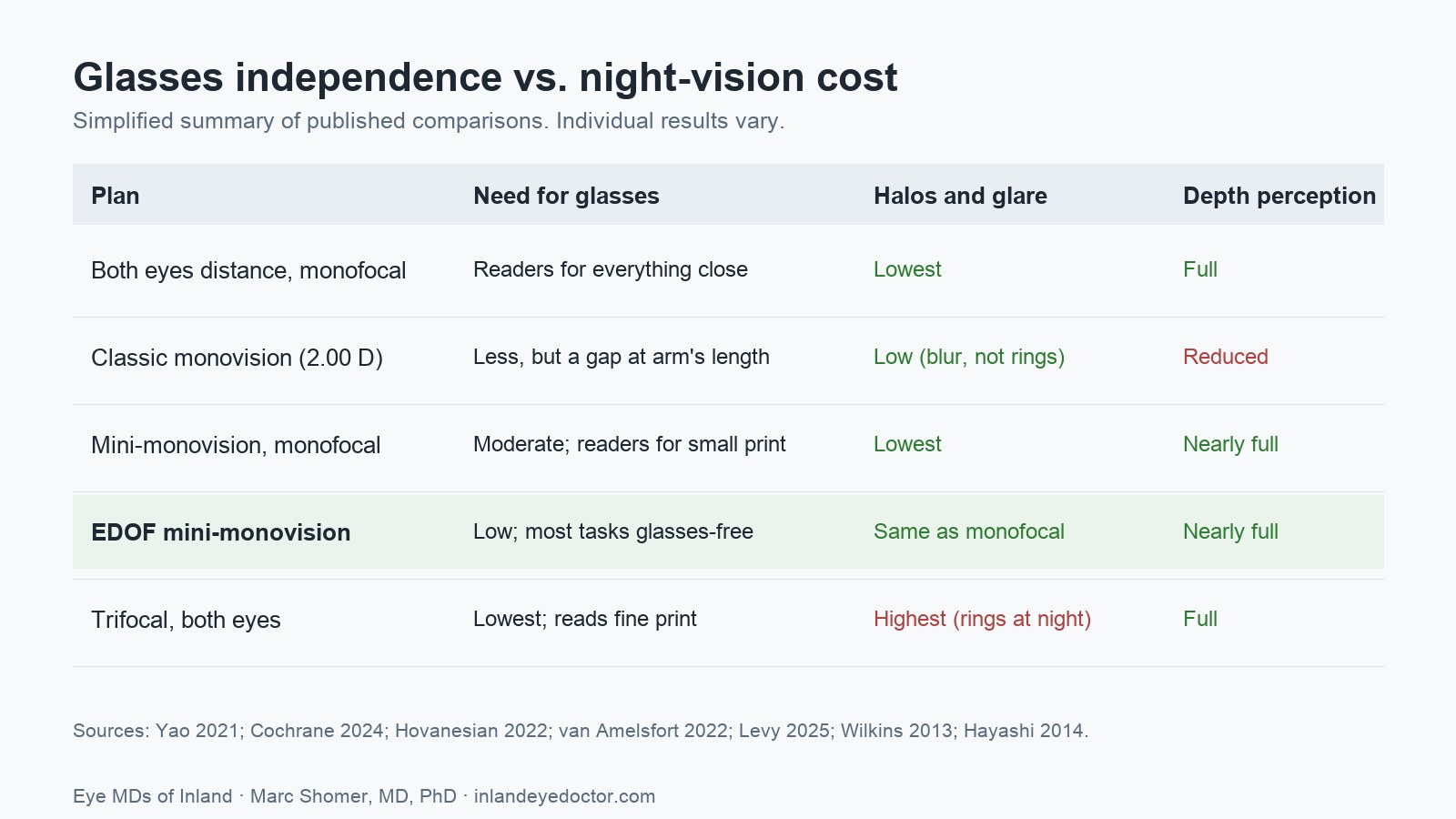
A non-diffractive extended depth of focus lens works differently. Lenses like TECNIS PureSee and Vivity have no rings. They use a smooth change in curvature to stretch a single focus into a longer continuous zone, so there is no second or third image competing with the first. That is why, in its FDA study, 97% of PureSee patients reported no very bothersome halos or glare, and why in the Vivity FDA trial the percentage of patients not bothered at all by halos (83%) was within a few points of the standard monofocal control group (89%). Our EDOF vs. multifocal comparison goes through those numbers in detail.
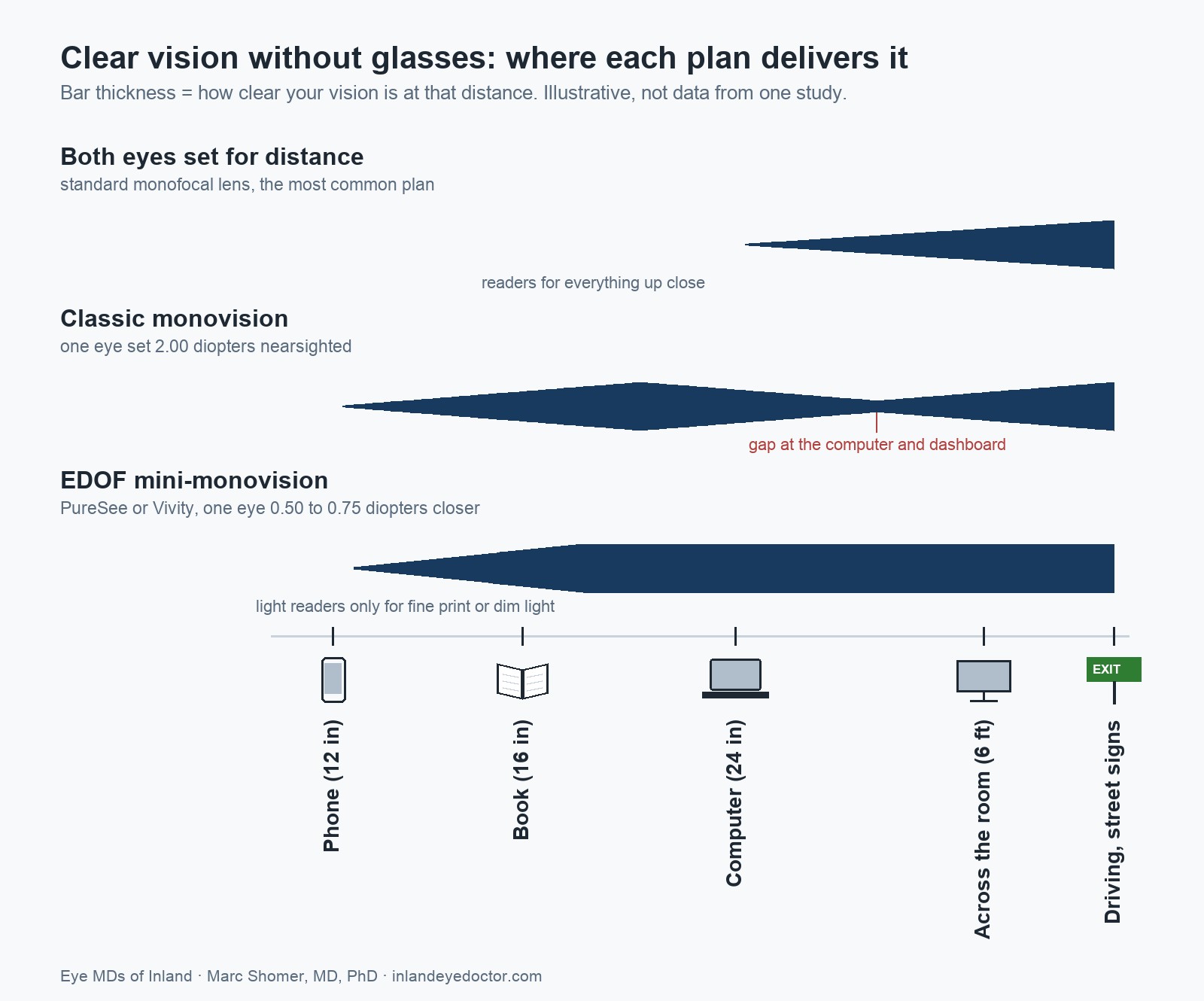
The catch is near vision. An EDOF lens on its own is excellent for distance and for arm's length, meaning the dashboard, the computer screen and the kitchen counter. It fades at true reading distance. In the largest meta-analysis comparing the two designs, trifocals delivered about a line and a half better uncorrected near vision than EDOF lenses. So a patient with an EDOF lens in both eyes set for distance usually sees beautifully all day and then picks up readers for a paperback or a pill bottle.
Mini-Monovision: Closing the Reading Gap Without Adding Rings
This is where mini-monovision comes in. Instead of aiming both eyes at exactly the same distance, I aim the dominant eye at distance and the other eye very slightly closer, usually by 0.50 to 0.75 diopters. In plain terms, a half diopter moves that eye's sharpest point from the horizon to about two meters, and three quarters of a diopter brings it to about 1.3 meters. Because an EDOF lens already stretches each eye's range toward near, that small nudge slides the second eye's entire zone of clarity into reading territory.
The brain does the rest. When the two eyes' ranges overlap, which they do with such a small offset, the brain simply uses whichever eye has the sharper picture at the moment and merges them into one. You do not experience it as one eye for far and one eye for near. You experience it as seeing well at every distance. This is the fundamental difference between mini-monovision and the old full monovision, and it is the reason the two feel so different to live with.
Critically, the offset adds no halos. We are not adding rings or splitting light. We are only choosing where a smooth, single-focus lens is sharpest. The night-vision profile of EDOF mini-monovision is the night-vision profile of the EDOF lens itself, which is close to a standard monofocal. In a prospective study of Vivity targeted for mini-monovision, 91% of patients reported no halos, 91% no glare and 100% no starbursts at three months. A 2024 Korean study that compared Vivity mini-monovision directly against a trifocal and a monofocal found that visual symptom scores with Vivity were about the same as with the monofocal, while the trifocal group scored highest for symptoms.
What the Research Shows
- Spectacle independence. A 2025 systematic review in Frontiers in Medicine pooled 19 studies and 1,530 patients who had mini-monovision with different lens types. Overall freedom from glasses was 51% with a standard monofocal, 55% with an enhanced monofocal and 63% with an EDOF lens, the highest of the three groups. Binocular distance and intermediate vision were excellent in every group.
- Small offsets are enough. In that review the EDOF studies used offsets of only 0.50 to 0.75 diopters, compared with 0.75 to 1.50 diopters for standard monofocal mini-monovision. The lens does part of the work, so the eyes stay closer together.
- Night vision stays clean. In a prospective Vivity mini-monovision series, 96% of patients were free of glasses for distance and 68% for intermediate tasks, with the 91% no-halo and no-glare figures above. In a separate multicenter comparison, 85% of Vivity patients reported no glare or halos or "just a little," compared with 69% of PanOptix trifocal patients.
- Depth perception is preserved. When Hayashi and colleagues compared a 0.75 diopter offset with a conventional 1.75 diopter offset in the same patients, stereoacuity (fine depth perception) and vision at one meter were significantly better with the smaller offset. A 2026 review in Survey of Ophthalmology reaches the same conclusion: mini-monovision "better preserves stereopsis and binocular vision" than conventional monovision.
I want to be careful not to oversell this. Trifocals still win on fine print. If reading the smallest text on a medicine label with no glasses at all is the single thing you care most about, a trifocal is the more likely route there, and we place them often. But for the many patients who tell me that night driving matters more than the fine print, EDOF mini-monovision gets them most of the way to glasses independence without paying the halo tax.
Why Old-Fashioned Monovision Is a Poor Comparison
Patients sometimes hear "monovision" and picture a friend or relative who tried it in contact lenses years ago and hated it. They are usually right to be wary, because traditional monovision is a genuinely different and harsher arrangement. Here is what it involves and why I rarely recommend it.
- A large gap between the eyes. Classic monovision sets the near eye 1.75 to 2.50 diopters nearsighted, two to four times the offset used in EDOF mini-monovision. At that difference the two eyes receive pictures too different for the brain to merge comfortably. Instead of blending, the brain has to suppress one eye at a time.
- Depth perception drops. Stereopsis depends on two similar images. Hayashi's study found stereoacuity significantly worse with a 1.75 diopter offset than with 0.75, and older work suggests that beyond about 1.5 diopters the loss becomes substantial. That matters on stairs and curbs, pouring a drink, parking a car, and in any sport with a ball.
- A hole in the middle. With a standard lens in each eye, one eye sharp at 16 inches and the other sharp at the horizon, neither eye is sharp at arm's length. That is exactly where the computer, the dashboard and the stove live. Patients describe reaching for glasses for the one distance they thought they had covered.
- Night driving suffers in a different way. Classic monovision does not create rings, but the near eye contributes a steady blur at night, sometimes with ghosting around lights, and the loss of depth cues makes judging distances harder in the dark.
- Adaptation is not guaranteed. In the contact lens literature roughly one patient in five never adapts to full monovision. With a permanent lens implant, a patient who cannot adapt faces glasses, a contact lens, or a second surgery.
- Even when it works, it is not very spectacle independent. In a randomized trial of 212 patients comparing bilateral multifocals with monovision, only 26% of the monovision group were free of glasses at four months, compared with 71% of the multifocal group. The multifocal group paid for that with more symptomatic halos, and 5.7% of them had a lens exchange within a year. Neither arm is the result I want for my patients. EDOF mini-monovision sits between them: much of the independence, almost none of the dysphotopsia.
Mini-monovision keeps the one good idea in monovision, a small deliberate difference between the eyes, and discards everything that made it unpleasant. The eyes stay similar enough to work as a team, so depth perception, balance and night driving are largely preserved. Pairing it with an EDOF lens removes the hole in the middle, because each eye already covers from distance to arm's length on its own.
Who Is a Good Candidate
EDOF mini-monovision works best for people whose days are mostly distance and arm's length, who drive at night, and who would be happy to keep one pair of readers in a drawer for fine print or dim restaurants. It requires healthy eyes. Before I recommend it I measure the cornea for astigmatism, which must be corrected with a toric version of the lens or the whole plan falls apart, I check the tear film, and I image the macula and optic nerve. A patient with significant macular disease is better served by a standard monofocal.
I also test it before surgery whenever I can. If you wear contact lenses or have a mild prescription, a trial with a slightly weaker lens in the non-dominant eye for a week tells us a great deal about how your brain will handle the offset. And because the two eyes are usually operated on a week or two apart, we have a natural checkpoint: after the first eye heals, we confirm its result and adjust the plan for the second eye if needed. In some patients the Light Adjustable Lens is another route to the same goal, because the offset can be fine-tuned after surgery with light treatments.
What It Feels Like to Live With
Most patients describe it as simply seeing well. They drive, watch television, work on the computer, cook, read their phone and read a menu in a well-lit restaurant without thinking about glasses. The honest limits are the tiniest print, long stretches of reading a paperback in bed, and threading a needle, where a pair of inexpensive readers makes life easier. Night driving is the part patients are most relieved about: headlights look like headlights.
If you would like to see the difference before your visit, our Lens Simulator & Guide (opens in a new tab) lets you set a different target for each eye and switch between lens designs on a daytime scene and a night driving scene, so "halo" and "reading distance" become things you can look at rather than take on faith.
Free app: the Cataract Surgery Guide for iPhone and Android
The same two-eye lens simulator, a plain-language guide to every lens type, what to expect on surgery day, and optional eye drop reminders are all in our free Cataract Surgery Guide app. It is completely free, requires no account, and collects no personal information.
The Bottom Line
You do not have to choose between reading glasses and halos. An extended depth of focus lens gives clean, continuous vision from distance to arm's length with a night-vision profile close to a standard lens. A small, deliberate offset between the eyes extends that range into reading distance without adding rings and without the depth-perception cost of old-fashioned monovision. For the right patient it is the most balanced plan in modern premium cataract surgery, and it is the one I discuss with nearly everyone who tells me they want to need their readers less but refuses to give up the night.
At Eye MDs of Inland in Upland we plan every lens choice from measurements and from a conversation about how you actually spend your day. If this approach sounds like you, request an appointment and we will test it together. Our related articles on mini-monovision versus monovision and the best premium lenses of 2026 cover the individual lens models in more depth.
Works Cited
1. Levy I, Shah RP, Mukhija R, Nanavaty MA. Outcomes of mini-monovision with monofocal, enhanced monofocal and extended depth-of-focus intraocular lenses: a systematic review. Frontiers in Medicine. 2025;12:1522383.
2. van Amelsfort T, Webers VSC, Bauer NJC, et al. Visual outcomes of a new nondiffractive extended depth-of-focus intraocular lens targeted for minimonovision: 3-month results of a prospective cohort study. Journal of Cataract and Refractive Surgery. 2022;48(2):151-156.
3. Hovanesian JA, Jones M, Allen Q. The Vivity extended range of vision IOL vs the PanOptix trifocal, ReStor 2.5 Active Focus and ReStor 3.0 multifocal lenses: a comparison of patient satisfaction, visual disturbances, and spectacle independence. Clinical Ophthalmology. 2022;16:145-152.
4. Hayashi K, Ogawa S, Manabe S, Yoshimura K. Binocular visual function of modified pseudophakic monovision. American Journal of Ophthalmology. 2015;159(2):232-240.
5. Kang S, Hsu J, Yoo SH. Pseudophakic mini-monovision. Survey of Ophthalmology. 2026;71(3).
6. Wilkins MR, Allan BD, Rubin GS, et al. Randomized trial of multifocal intraocular lenses versus monovision after bilateral cataract surgery. Ophthalmology. 2013;120(12):2449-2455.
7. Yao K, et al. Comparison of trifocal or hybrid multifocal-extended depth of focus intraocular lenses: a systematic review and meta-analysis. Scientific Reports. 2021.
8. Tavassoli S, Ziaei H, Yadegarfar ME, et al. Trifocal versus extended depth of focus (EDOF) intraocular lenses after cataract extraction. Cochrane Database of Systematic Reviews. 2024;7:CD014891.
9. Alcon. AcrySof IQ Vivity IOL: clinical trial visual disturbance data (QUVID questionnaire). Manufacturer data from the randomized pivotal trial.
10. Johnson & Johnson. FDA approval of TECNIS PureSee intraocular lens. Press release, March 12, 2026.
11. Won YK, Choi SH, Chung TY, Lim DH. Clinical outcomes after bilateral implantation of a wavefront-shaping EDOF IOL with mini-monovision. Journal of Clinical Medicine. 2024;13(11):3225.
12. Jain S, Arora I, Azar DT. Success of monovision in presbyopes: review of the literature and potential applications to refractive surgery. Survey of Ophthalmology. 1996;40(6):491-499.
