
What if cells in the retina that were never designed to see light could be taught how to see it?
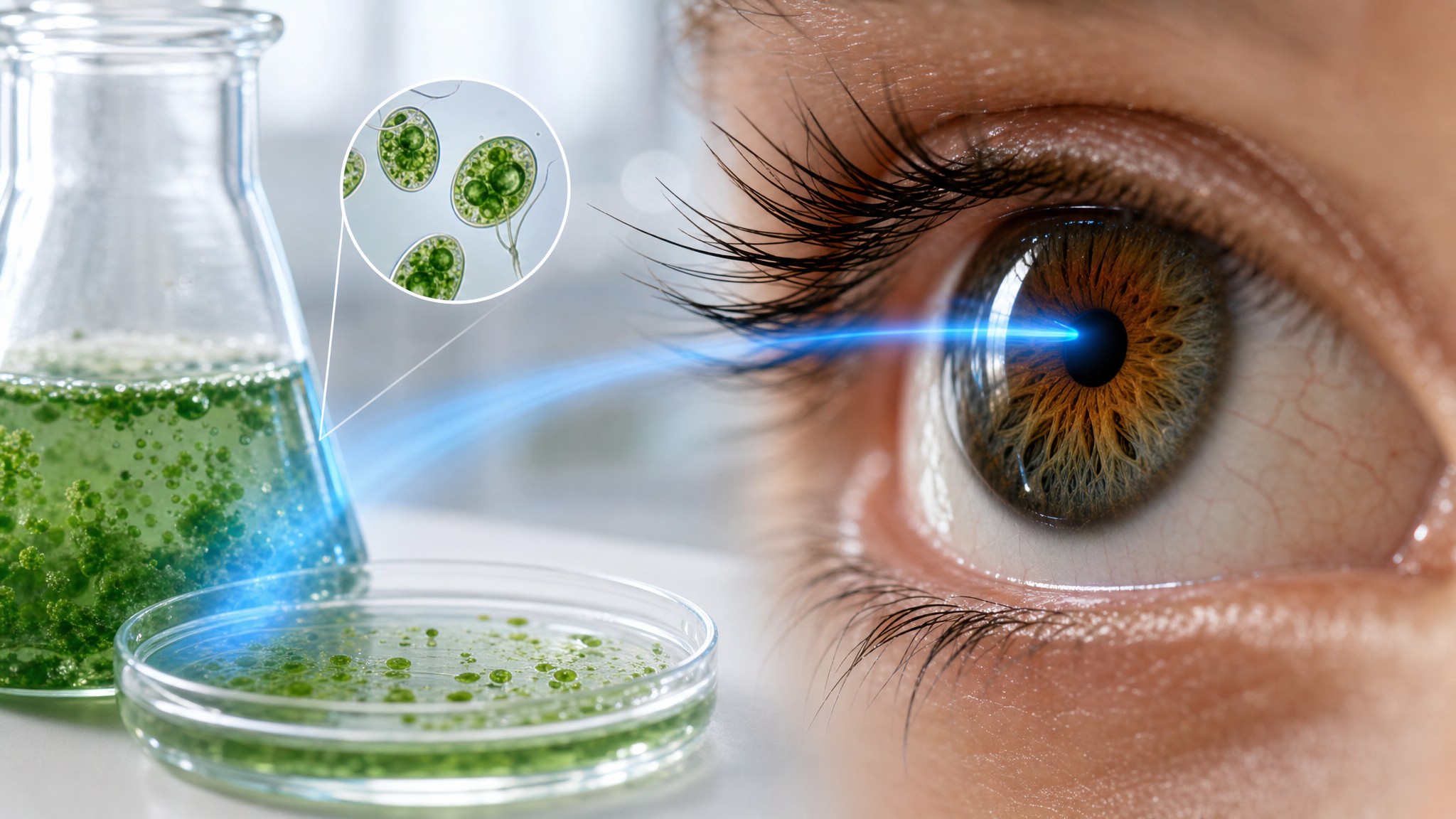
That may sound like science fiction, but it is one of the remarkable possibilities emerging from a field called optogenetics: using light, plus a borrowed gene, to control the electrical activity of nerve cells.
On October 5, 2026, the Nobel Prize in Physiology or Medicine was awarded to Karl Deisseroth, Peter Hegemann and Georg Nagel "for their discoveries concerning light-gated ion channels and optogenetics." Much of this work was aimed at understanding the brain. For ophthalmologists, there is another fascinating possibility. Researchers may be able to use the same technology to help a damaged retina detect light again.
The key idea is surprisingly simple. Instead of trying to replace every damaged light-sensing cell in the retina, scientists may be able to teach other surviving retinal cells how to sense light.
I want to be clear from the start, because patients living with vision loss deserve a straight answer. This is a Nobel Prize winning discovery, and it is still a long way from restoring lost vision today. No optogenetic treatment is available in my office or in any other eye clinic. In this article I explain the science, what has actually been shown in people, and how far we still have to go.
The short version
- What won the Nobel Prize: the discovery of light-gated ion channels, which are proteins from green algae that open when light hits them, and the method of using them to switch nerve cells on with light.
- Why eye doctors care: the same proteins might make surviving retinal cells sensitive to light after the eye's own light sensors, the rods and cones, have died.
- What has been shown in people: in 2021, a man blind from retinitis pigmentosa was able to locate, count and touch objects after treatment, while wearing special goggles. Larger studies have followed.
- What is available today: nothing yet. As of October 2026, no optogenetic treatment is approved by the U.S. Food and Drug Administration (FDA). One is under FDA review for retinitis pigmentosa with severe vision loss.
- What it will not do: restore normal vision. Even in the best results so far, patients gain limited, low-resolution vision. It also cannot help vision lost from glaucoma or other optic nerve damage.
How Does the Retina Normally See?
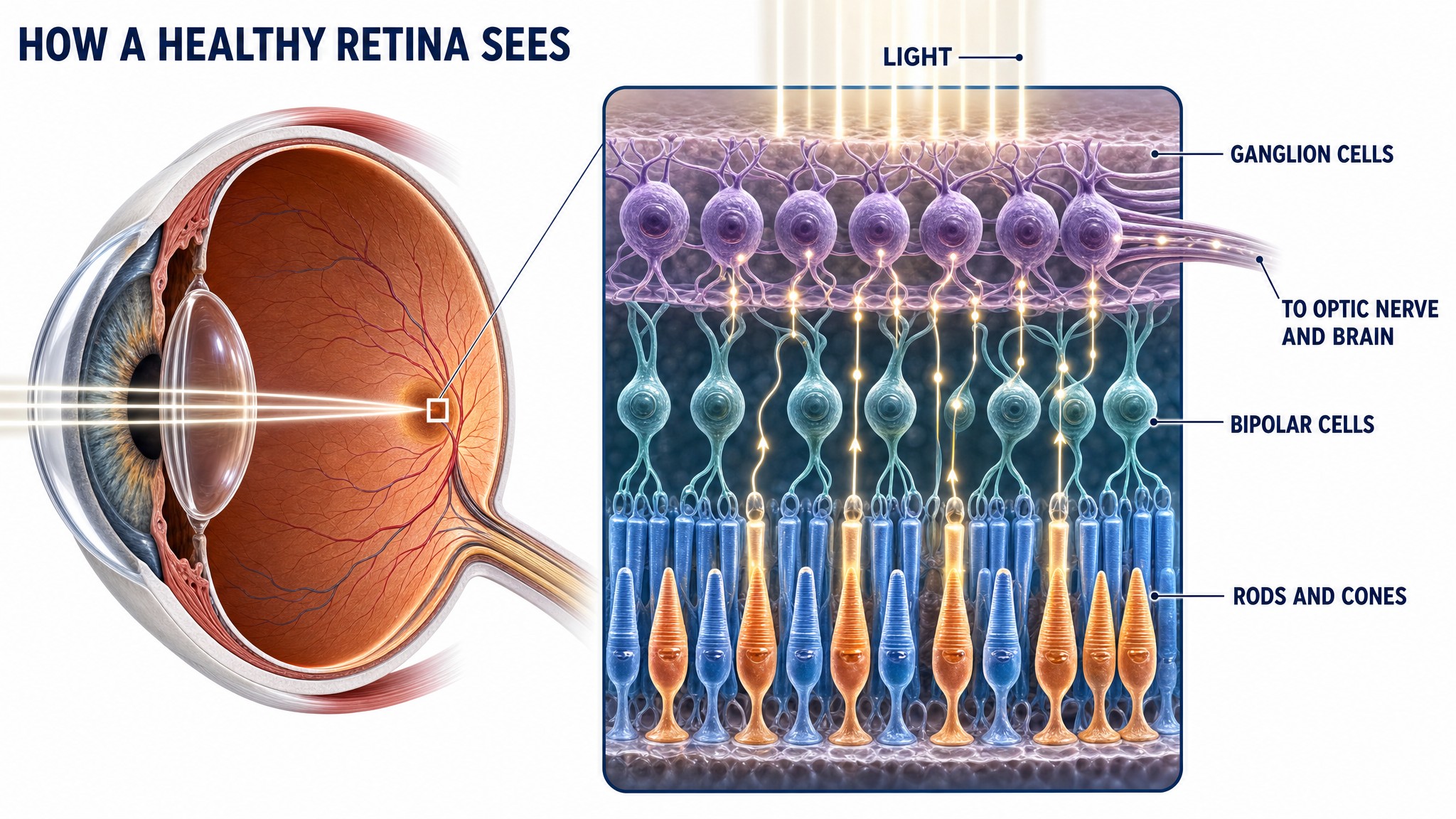
The retina is the thin layer of nerve tissue lining the back of the eye. You can think of it a little like the digital sensor inside a camera.
When light enters the eye, it eventually reaches specialized cells in the retina called photoreceptors. There are two major types:
- Rods, which are extremely sensitive to light and help us see in dim conditions.
- Cones, which provide detailed central vision and color vision.
These cells perform an extraordinary job. They take something physical, a particle of light, and turn it into an electrical signal.
That electrical information is then processed by several additional layers of retinal nerve cells. The signal passes from the rods and cones to bipolar cells, then to ganglion cells, whose long fibers bundle together to form the optic nerve. The brain ultimately turns those signals into the world we see.
What Happens When the Photoreceptors Die?
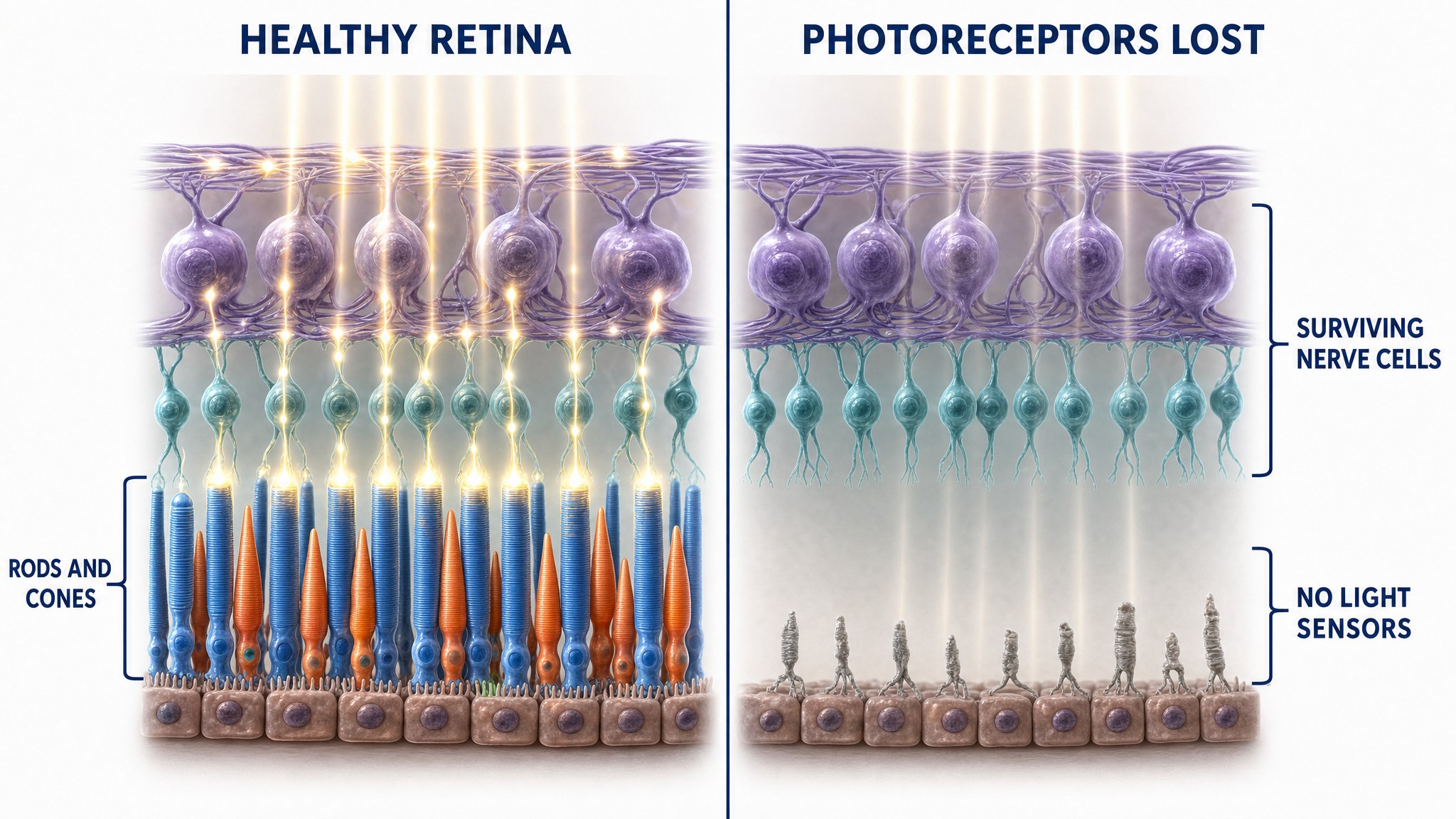
In diseases such as retinitis pigmentosa and some other inherited retinal degenerations, the rods and cones gradually become damaged and disappear.
This creates a major problem. Light may still enter the eye perfectly well. The cornea can be clear. The lens may be clear. The optic nerve may still be capable of transmitting information. Many of the deeper nerve cells of the retina may still be present.
But the cells responsible for detecting the light in the first place are gone.
It is somewhat like having a camera with a functioning computer and wiring, but an image sensor that has stopped working. Traditionally, that has been an enormous obstacle. If the photoreceptors are gone, how do you get light information into the remaining retinal circuitry?
The Nobel Prize Discovery: A Light Switch Borrowed from Algae
This is where optogenetics becomes so exciting.
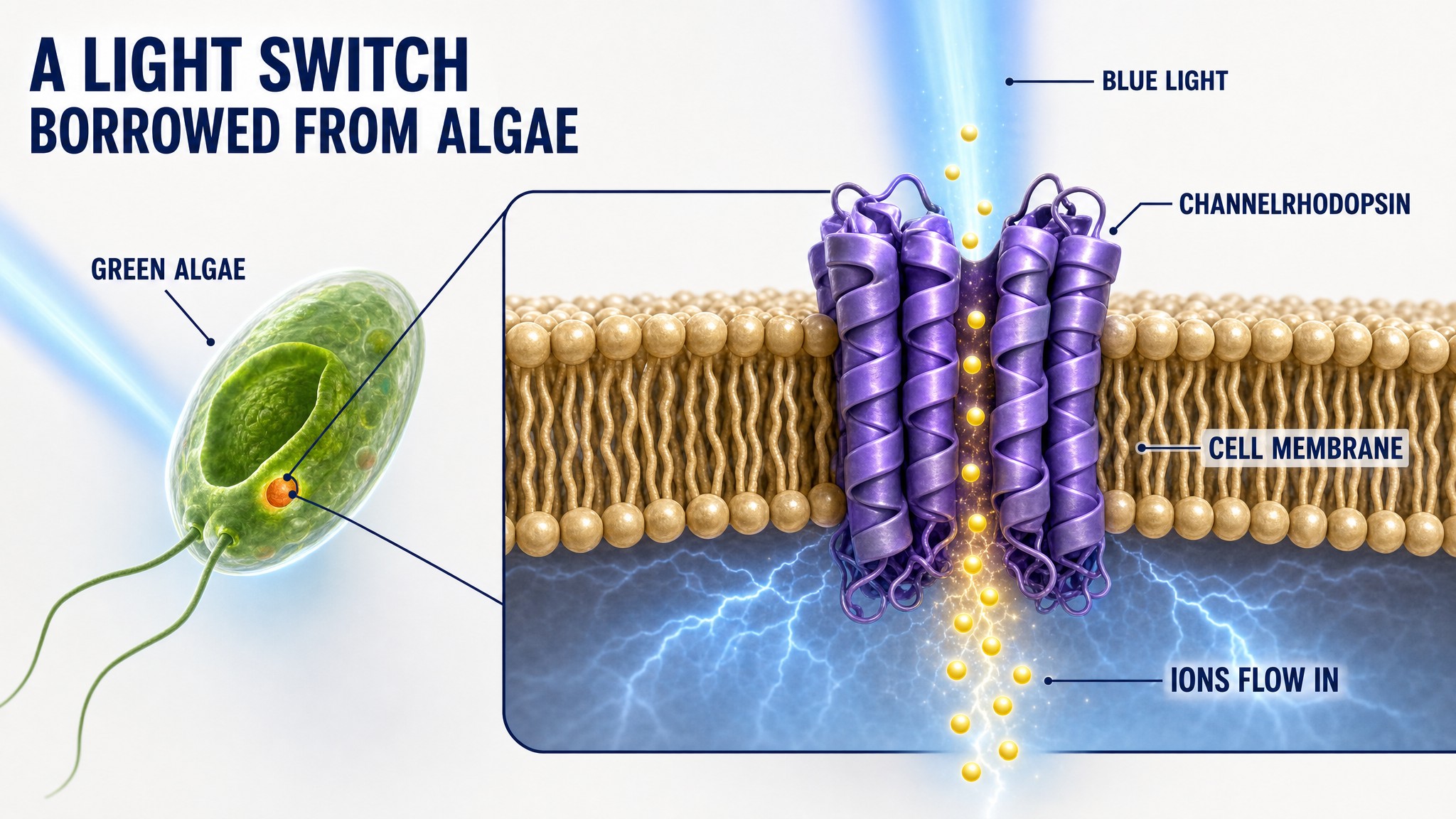
The story starts with a tiny single-celled green alga called Chlamydomonas, which swims toward light. Peter Hegemann, of Humboldt University of Berlin, and Georg Nagel, of the University of Würzburg, discovered the protein that makes this possible. It is called channelrhodopsin.
Channelrhodopsin is a light-gated ion channel. In plain terms, it is a tiny gate in the outer membrane of a cell. When light strikes it, the gate opens and electrically charged particles called ions flow into the cell. That flow changes the electrical activity of the cell. According to the Nobel Assembly, Hegemann and Nagel found that regardless of which cell they put the protein in, that cell became sensitive to light.
Karl Deisseroth, of Stanford University, then took the decisive next step. He introduced the gene for channelrhodopsin into nerve cells and showed that shining blue light on those cells triggered a nerve signal. Later, he made this light-controlled switch work in the brains of living mice.
That combination, a gene that makes a cell respond to light plus light used as the on switch, is optogenetics. It has transformed neuroscience, because researchers can now switch specific nerve cells on or off and see what they do.
Researchers soon realized something remarkable. What if we put the genetic instructions for one of these light-sensitive proteins into a retinal nerve cell that normally cannot detect light? That cell could potentially become light-sensitive. In other words, we could give a retinal cell an ability it never had before. We could, in a sense, teach it to see light.
Bypassing the Damaged Photoreceptors
This is the part I find most fascinating.
In an advanced retinal degeneration, the original rods and cones may already be damaged beyond repair. Instead of trying to bring those exact cells back, researchers can potentially go around them.
A gene therapy treatment delivers the instructions for making a light-sensitive protein into surviving retinal cells. The instructions are carried by a harmless, engineered virus and injected into the clear gel that fills the eye. This is the same route we use for the injections given in the office for macular degeneration and diabetic eye disease.
The cells that receive the new gene are deeper in the retinal network: the ganglion cells in some treatments, the bipolar cells in others. Normally, these cells only pass along signals that started in the rods and cones. They are not the eye's light sensors. After receiving the light-sensitive protein, they can respond directly to light.
The pathway becomes:
Light, then a newly light-sensitive retinal cell, then the optic nerve, then the brain
rather than:
Light, then a rod or cone, then the retinal circuitry, then the optic nerve, then the brain
The damaged photoreceptors are effectively bypassed.
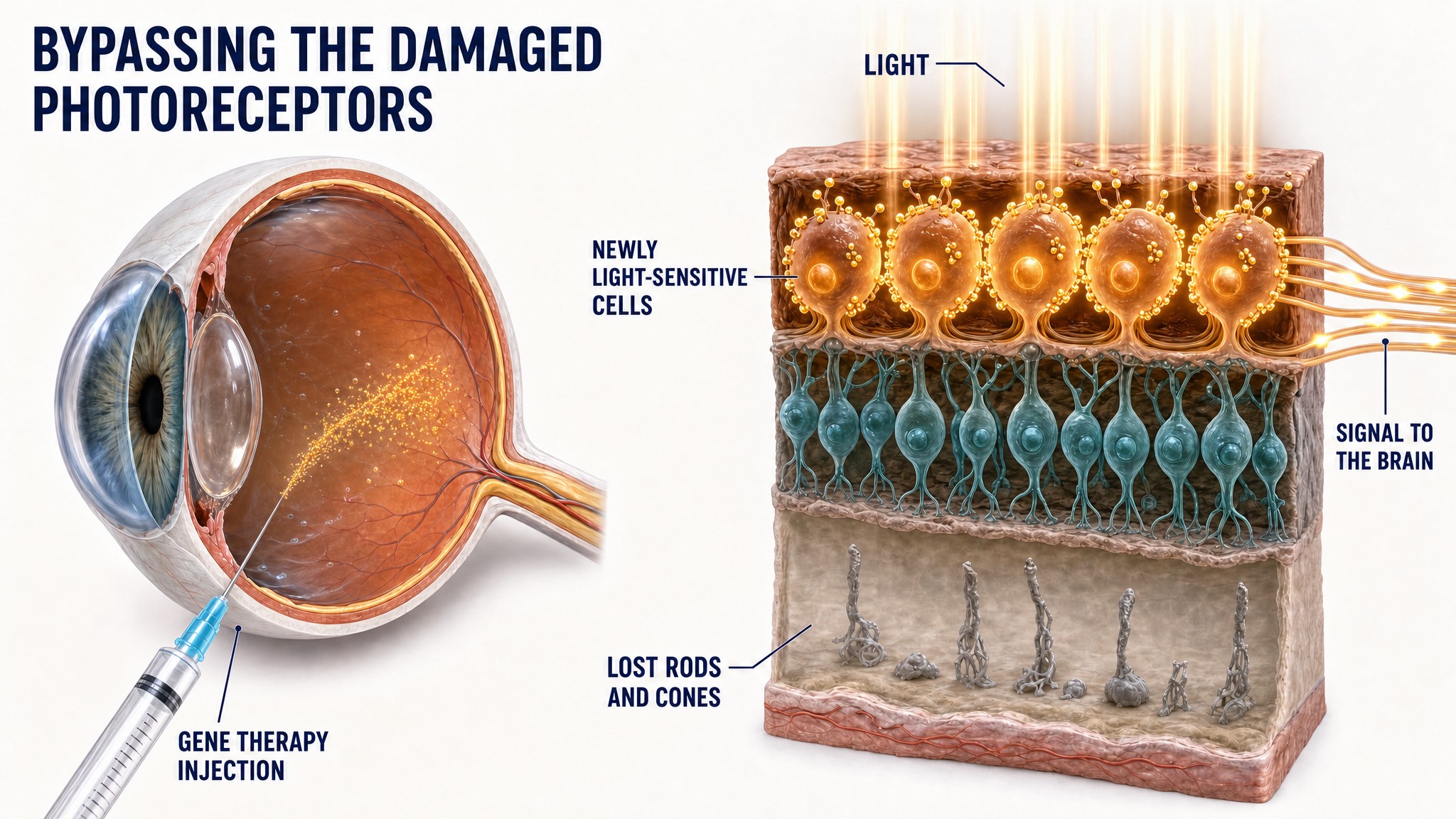
The easiest way to picture this is to imagine adding a new switch to a cell. The cell already contains electrical machinery. It already connects with other nerve cells. It already has a pathway toward the brain. What it lacks is the ability to recognize light. Optogenetics attempts to install that missing light detector.
That is what makes this technology so different from simply shining more light into an eye. The treatment is not really about the light itself. It is about changing the retinal cells so they can respond to the light.
Has This Actually Been Tried in People?
Yes.
The first human proof of concept was published in Nature Medicine in 2021 by Dr. José-Alain Sahel, Dr. Botond Roska and their colleagues. The patient was a 58-year-old man who had been diagnosed with retinitis pigmentosa 40 years earlier. Before treatment, he could only tell light from dark.
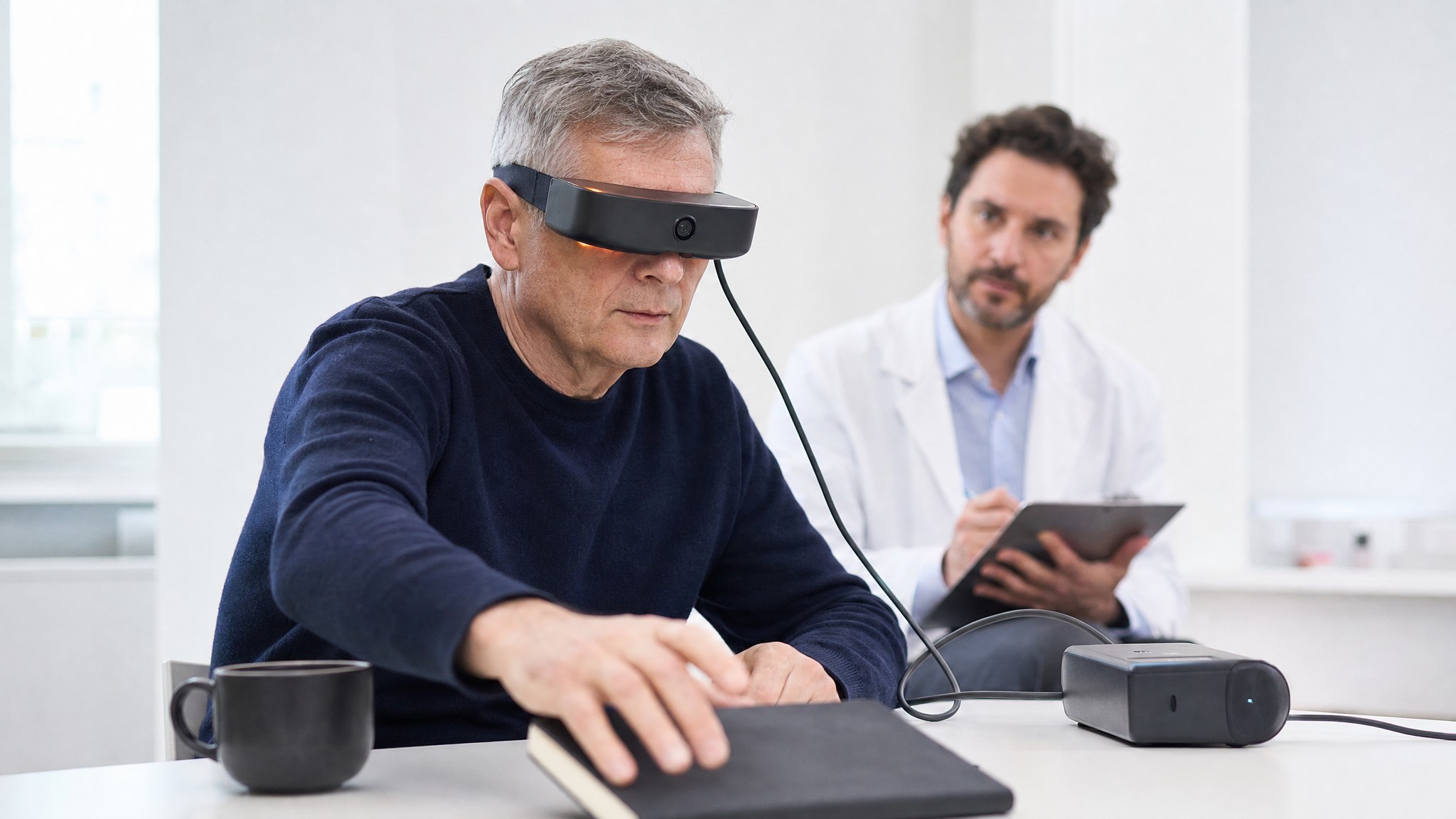
One of his eyes was injected with a gene therapy carrying a light-sensitive protein called ChrimsonR, aimed at his surviving retinal ganglion cells. He also wore specialized goggles that detected the visual scene and projected a matching pattern of amber light onto his retina.
After months of training, he was able to perceive, locate, count and touch objects on a table using the treated eye, but only while wearing the goggles. Recordings of his brain activity showed the visual part of the brain responding when he looked at the objects. Before the injection, he could not detect the objects with or without the goggles.
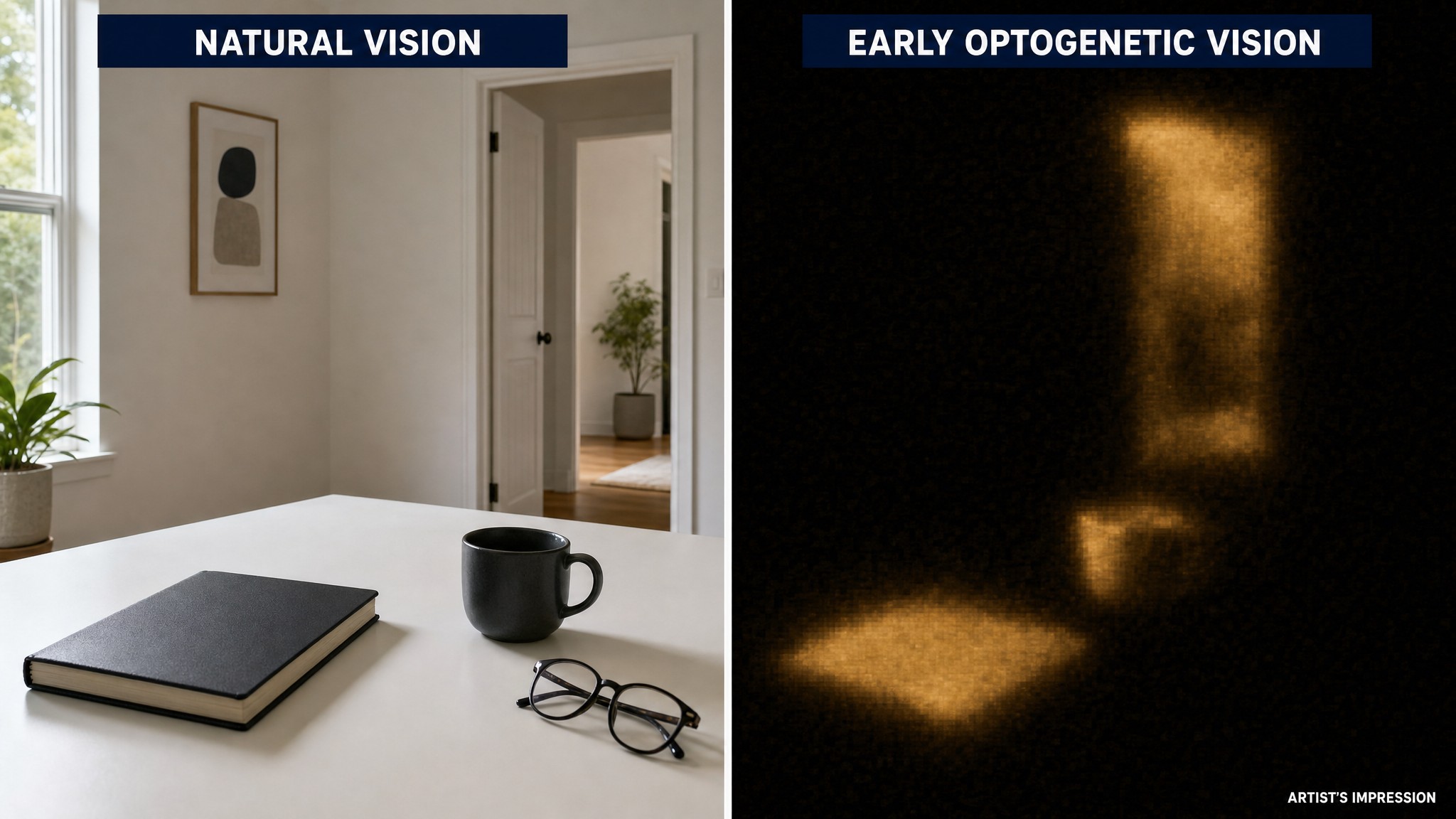
This was not normal vision. It did not restore 20/20 eyesight, or anything close to it. But scientifically, the significance was enormous. The authors described it as the first reported case of partial recovery of function in any neurodegenerative disease after optogenetic therapy.
Why Are Special Goggles Sometimes Needed?
The new light-sensitive proteins do not respond to ordinary indoor light nearly as well as healthy rods and cones do. Goggles can help solve this problem. A camera in the goggles captures the surroundings. A processor then converts that information into a bright pattern of light, in the color the new protein responds to, and projects it onto the retina.
Think of the goggles as translating the outside world into a language the newly light-sensitive retinal cells understand. The brain then has to learn how to interpret this new source of information, which is why training is part of the treatment.
What Has Happened Since 2021?
The research has moved from a single patient to controlled clinical trials. The furthest along is a treatment from Nanoscope Therapeutics called sonpiretigene isteparvovec (brand name Mogenry, formerly MCO-010). It targets the bipolar cells and is designed to work in ordinary room light, without goggles, after a single injection given in the office.
In its main trial, called RESTORE, 27 patients with advanced retinitis pigmentosa were randomly assigned to the treatment (18 patients) or to a sham injection (9 patients). At one year, vision in the high-dose group was better than in the sham group by an average of roughly three lines on a low-vision eye chart, as reported from the trial. In September 2026, the company announced that the FDA had accepted its application for approval. A decision is expected in the first half of 2027.
That is real progress, and it deserves some perspective. This was a small trial. The patients started with severe vision loss, so a gain of three lines still leaves very limited vision. And the treatment has not been approved.
Will This Restore Normal Vision? A Reality Check
Not yet, and not soon.
It is important to separate the remarkable scientific possibility from what patients can expect today. Here is where things stand in October 2026.
| Step | Status |
|---|---|
| Basic discovery (light-gated ion channels and optogenetics) | Done. Recognized with the 2026 Nobel Prize |
| First human proof of concept | Done in 2021, in one patient, with goggles |
| Controlled clinical trial | One small trial completed in retinitis pigmentosa |
| FDA approval | None yet. One application is under review |
| Available in eye clinics | No |
| Restores normal vision (reading, driving, recognizing faces) | No, and not expected from current approaches |
There are good scientific reasons why this is so hard:
- Sensitivity. Healthy rods and cones work from starlight to bright sunlight. The borrowed proteins are far less sensitive and cannot adjust across that range, which is why some approaches need goggles.
- Detail and color. Natural vision comes from millions of rods and cones, with three types of cones for color. Current treatments add a single light-sensitive protein to a much smaller set of cells. The result is coarse, low-resolution vision without natural color.
- A rewired retina. After the photoreceptors die, the remaining retinal circuitry slowly changes. The new signal enters a network that is no longer working the way it was built to.
- The brain has to learn. The signal the brain receives is unlike anything it has seen before. Patients need training, and results vary.
- It only helps certain eyes. The treatment depends on surviving inner retinal cells and a working optic nerve. It cannot help vision lost from glaucoma, optic nerve disease or stroke.
- Long-term questions. A gene therapy is given once and cannot be taken back. Follow-up so far covers only a few years.
So the first goals are practical ones. Can someone who could not see an object tell where it is? Can they find a doorway? Can they notice movement? Can they get around more independently? For a person with profound blindness, even that limited vision could be life-changing. It is still very far from the sight they lost.
Why the Nobel Prize Matters for Eye Care
The scientists recognized by the 2026 Nobel Prize did not set out to build a treatment for blindness. Their discoveries created a completely new way of controlling the electrical activity of cells using light, and that tool has transformed neuroscience.
But one of its most fascinating possible medical uses is in the eye. The retina is nervous tissue. It is essentially an extension of the brain located inside the eye. And unlike most of the brain, the retina has one enormous advantage for optogenetics: light can reach it naturally. We do not have to implant a light source deep inside the head. The eye already has a transparent optical system designed to deliver light directly to the retina.
There is also something beautiful about the history. Scientists studying how tiny algae respond to light discovered a protein that turns light into electrical activity. That protein became one of the most important tools in modern neuroscience. Now researchers are bringing the same principle back to vision itself, hoping that a retinal nerve cell that was never designed to act as a photoreceptor can help a blind eye detect the world again.
What This Means If You or a Family Member Has Vision Loss
If you have retinitis pigmentosa or another inherited retinal disease: stay connected with a retina specialist who treats inherited retinal diseases, and ask about genetic testing. Clinical trials are listed at ClinicalTrials.gov, and the Foundation Fighting Blindness tracks research in plain language. Be cautious of any clinic that offers to sell you an optogenetic or stem cell treatment today. Legitimate research treatments are given in clinical trials, not sold.
If your vision loss has another cause: most of the vision loss I see every day comes from conditions we can treat now, including cataracts, glaucoma, diabetic retinopathy and macular degeneration. For these, the most important step is not a future technology. It is a dilated eye examination while the vision can still be protected. If a cataract is what is blurring your vision, that is something we can fix today, and our Lens Simulator shows what each lens implant option looks like.
Optogenetics is one of the most exciting frontiers in ophthalmology, and I will be following it closely. When there is something real to offer patients, I will write about it here.
Eye Care in Upland and the Inland Empire
At Eye MDs of Inland in Upland, California, we provide complete medical and surgical eye care, including cataract surgery, glaucoma care, and in-office treatment for macular degeneration and diabetic eye disease. If you have noticed a change in your vision, call us at 909-981-9800 or request an appointment online.
Important perspective: optogenetic vision restoration remains experimental and is being studied in clinical research. It is not an established treatment, and it is not a promise that sight can be restored. This article is general education, not medical advice. Please discuss your own eyes with your physician.
Works Cited
1. Nobel Assembly at Karolinska Institutet. The Nobel Prize in Physiology or Medicine 2026. Announced October 5, 2026.
2. Sahel JA, Boulanger-Scemama E, Pagot C, et al. Partial recovery of visual function in a blind patient after optogenetic therapy. Nature Medicine. 2021;27(7):1223-1229.
3. Healio Ophthalmology. Optogenetics, goggles increase visual perception in case of inherited retinal dystrophy. June 3, 2021.
4. Nanoscope Therapeutics. FDA acceptance of Biologics License Application for Mogenry for the treatment of retinitis pigmentosa with severe vision loss. Press release, September 9, 2026.
5. Optometry Times. FDA accepts Nanoscope's BLA for MCO-010 in retinitis pigmentosa. September 2026.
6. Glance by Eyes On Eyecare. FDA accepts Nanoscope's optogenetic gene therapy BLA for RP. September 10, 2026.