
What Choices Do I Need to Make for My Cataract Surgery?
By: Marc Shomer, MD PhD
Board Certified Ophthalmologist and Vision Surgeon
Clinical Instructor of Ophthalmology at USC Doheny Eye Institute
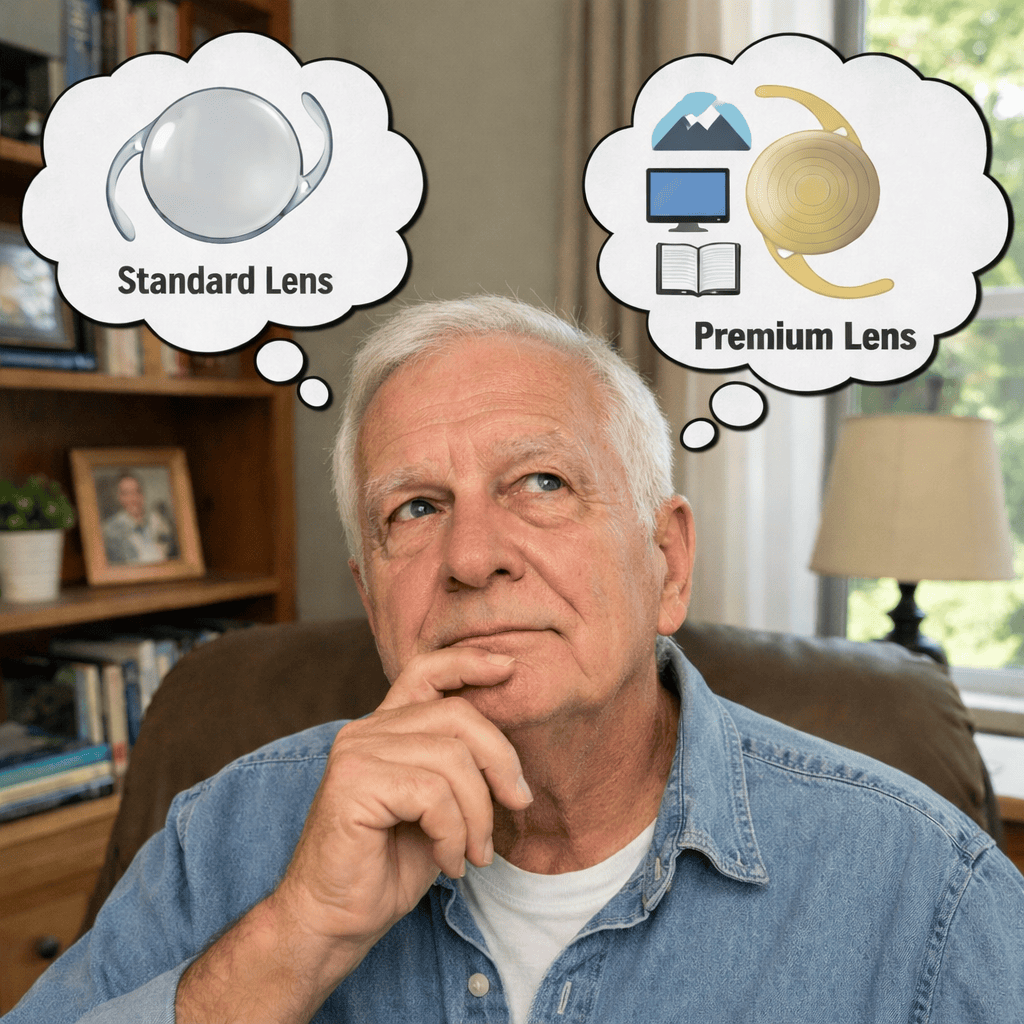
If you’ve been told you need cataract surgery, you’re not alone—and you’re not “getting old.” A cataract is simply a cloudy natural lens inside the eye. Cataract surgery removes that cloudy lens and replaces it with a clear, permanent lens implant. For most people, it’s a once-in-a-lifetime procedure—and the lens implant is designed to last forever.
But here’s the part most patients don’t realize at first: cataract surgery isn’t just about removing the cataract anymore. If you’re a good candidate, it can also be an opportunity to improve how you see day-to-day—sometimes with much less dependence on glasses.
Below are the biggest choices you’ll make, explained in plain language.
Choice #1: Standard Lens (Covered by Insurance) vs. Advanced Lens (More Visual Freedom)
The standard lens: what insurance covers
Most insurance plans cover cataract surgery with a basic monofocal lens implant. This does a great job at the most important goal:

MONOFOCAL
- Removes the cataract
- Restores clear vision
But there are limitations:
- A standard lens usually does not correct astigmatism
- It typically does not give a full range of vision (distance + computer + near)
So most people with a standard lens end up more dependent on glasses:
glasses for reading
- often glasses for computer work
- sometimes glasses even for distance (especially if astigmatism is present)
Advanced technology lenses: “visual freedom”
If your eyes are healthy and you’re a strong candidate, you may have the option to choose an advanced lens implant that can help you:
- reduce or correct astigmatism
- see clearly across multiple distances (distance, intermediate/computer, and near/reading)
- rely on glasses much less often
Many studies report high rates of spectacle independence with presbyopia-correcting lenses (often around 9 out of 10 patients achieving complete independence in certain trifocal or multifocal IOL analyses). (pmc.ncbi.nlm.nih.gov)


This is what many patients mean when they say they want visual freedom:
- Waking up and seeing the clock clearly
- Driving and reading signs comfortably
- Looking at your phone without instantly reaching for readers
- Feeling more relaxed in your daily routine because your vision “just works”
Important: These advanced lenses are typically not covered by insurance, because they go beyond “cataract removal” and into “vision optimization.”
The trade-offs: halos, glare, and satisfaction
Advanced lenses can be amazing—but they aren’t perfect for everyone.
Some people notice:
- halos around lights at night
- glare or starbursts (especially early on)
- a period of “neuro-adaptation” while the brain adjusts
Most patients are satisfied, and in some reports 94–97% of patients with newer multifocal lenses would choose the same lens again. (reviewofophthalmology.com)
But a small minority are not happy with the quality of vision and may consider additional treatment—or rarely, lens exchange. (Lens exchange is uncommon overall, but it does happen, and rates vary across studies and populations.) (valueinhealthjournal.com)
Bottom line: Advanced lenses can deliver more freedom, but they come with visual trade-offs that need to match your lifestyle and your eye health.
Who is a “great candidate” for visual freedom lenses?
In general, the best candidates have:
- a healthy cornea
- a healthy macula/retina (no significant macular degeneration)
- limited dry eye disease (or dry eye that can be treated first)
- realistic expectations (you’re aiming for less glasses, not “robot vision”)
Your surgeon will evaluate measurements and eye health carefully before recommending these lenses.
Most people make the best decision with their surgeon’s help, so please don’t feel like you have to figure this out on your own. This article is meant to educate you and give you the vocabulary to understand the options, but it’s completely normal for all of this to feel overwhelming at first. In your consultation, your surgeon will walk you through the choices, learn what matters most to you (driving, screen time, reading, hobbies, night vision), review the health and measurements of your eyes, and then recommend the lens option that best fits your goals and lifestyle. Think of this as a guide to start the conversation and your surgeon’s job is to help you narrow it down and feel confident in the final choice.
Choice #2: Full range multifocal lens vs Extended Depth of focus lens
When choosing an advanced technology lens for cataract surgery, many patients decide between a full-range multifocal lens and an extended depth of focus (EDOF) lens. A multifocal lens is designed to give the widest range of vision: distance for driving, intermediate for computer and arm’s-length tasks, and near vision for reading: which can greatly reduce dependence on glasses. The trade-off is that because light is split to create multiple focal points, some patients may notice visual side effects such as halos or glare around lights, especially at night.
This is an example of an EDOF lens
distance and computer are good but near vision may be more blurry.
An EDOF lens takes a different approach by stretching vision smoothly from distance into intermediate range, which works very well for driving, daily activities, and computer use. The main advantage of EDOF lenses is a lower risk of halos and glare and often better night-time visual quality, but close-up reading vision is not as strong, so reading glasses are more commonly needed. In simple terms, multifocal lenses maximize visual range with a slightly higher risk of visual symptoms, while EDOF lenses prioritize visual comfort and clarity with fewer side effects, at the cost of near reading strength.
Additionally, an EDOF lens can be paired with a very mild difference in prescription between the two eyes to further expand your overall range of vision. For example, one eye may be targeted for crisp distance and computer vision, while the other eye is set just slightly more “near-focused,” which can improve reading ability but may make distance vision in that eye a touch less sharp. Because the offset is small, most of my patients tolerate it very well and still feel their vision is balanced. This approach is different from traditional monovision, which uses a much larger difference between the two eyes.
Common lens implants used for visual freedom
You don’t have to decide this on your own: your surgeon will help guide you to the right choice. This section is just to inform you, and it’s normal if it feels overwhelming at first.
These 3 lens provide the most range of vision: Distance, Computer, and reading range. Not everyone is a good candidate for these lenses and there are some potential side effects but the highest rate of spectacle independence. I typically use these lenses for my patients who do not want reading glasses and are easy going about possible visual side effect at night.
- Alcon PanOptix Pro – A popular trifocal IOL that provides good vision at distance, intermediate, and near, helping many patients with everyday tasks like reading and driving without glasses.
- Bausch + Lomb enVista Envy –multifocal/trifocal presbyopia‑correcting lens aiming for strong visual performance across distances.
- Johnson & Johnson TECNIS Odyssey – A trifocal IOL that also targets distance, intermediate, and near vision with design features intended to balance visual clarity and visual phenomena
EDOF (Extended Depth of Focus) Lens Options
These lens provide a greater range of vision than a standard lens but the reading vision might still require glasses. These lenses are excellent for the computer and driving and do not have as much side effects of halos as the lenses above. A small off set in prescription can be used with these lenses to provide a larger range of vision as well. I usually seem to give these lenses to patient who still drive at night or have little tolerance to possible visual side effects.
- Alcon Clareon Vivity – A non‑diffractive EDOF IOL that provides a continuous range of clear vision from distance to computer range with reduced glare and halos.
- Bausch + Lomb Aspire – lens is designed to provide clear distance and strong intermediate computer vision with a smoother visual profile and a lower risk of halos and glare compared to multifocal lenses.
- Johnson & Johnson TECNIS Symfony – Another EDOF IOL that offers extended focus from distance to intermediate with generally fewer visual side effects then a multifocal IOLs.
Choice #3: Laser-Assisted Cataract Surgery vs. Traditional “Manual” Cataract Surgery
Traditional (manual) cataract surgery: how it works
In standard cataract surgery, your surgeon:
- makes a small entry incision with a fine blade
- creates a circular opening in the front of the lens capsule (a controlled “tear”)
- uses tools to break the cataract into smaller pieces
- removes the pieces with a gentle suction device and ultrasound energy
- places the new lens implant
This approach is highly effective and has a long track record.
Laser-assisted cataract surgery: what’s different
Laser-assisted cataract surgery uses a femtosecond laser to perform some of the key steps:
- creates a precise, beveled incision
- makes a very accurate circular opening in the capsule
- pre-softens or breaks up the cataract into segments before removal
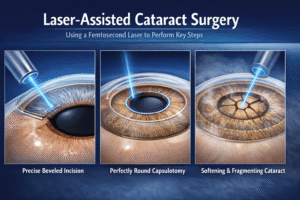
The potential advantages include:
- more precision in certain steps
- less ultrasound energy needed inside the eye in many cases (aao.org)
- potentially more predictable capsulotomy and lens positioning/centration (pmc.ncbi.nlm.nih.gov)
For many routine cases, long-term vision outcomes are similar between laser-assisted and traditional surgery, because both remove the cataract and implant a new lens. (aao.org)
Where laser can be especially helpful:
- dense cataracts
- more complex cases
- eyes with weaker supporting structures where precision may add safety margin (pmc.ncbi.nlm.nih.gov)
Putting It All Together: The Two main Decisions
When you strip it down, most cataract decisions come back to this:
1) Lens choice
- Standard lens (insurance-covered): cataract removed, great clarity, but more glasses dependence
- Advanced lens (out-of-pocket): potential for astigmatism correction + broader range of vision, less glasses dependence, with a higher chance of halos/glare and the need for careful candidate selection (pmc.ncbi.nlm.nih.gov)
2) Surgical method
- Traditional surgery: excellent, proven approach
- Laser-assisted: more precise steps, often less ultrasound energy, especially helpful in denser/complex cataracts, with similar long-term outcomes for many routine cases (aao.org)
The Takeaway
Cataract surgery is more than “getting the cloudy lens out.” It’s an opportunity to choose the kind of vision you want for the next chapter of your life.
Because it’s typically a one-time surgery and the lens implant is designed to last permanently, it’s worth asking yourself:
- Do I want the simplest covered option—and accept more glasses dependence?
- Or, if I’m a good candidate, do I want to pursue visual freedom with advanced lens technology, understanding the trade-offs?
- There is no perfect solution and nothing works better than the lens you were born with. The advanced technology lens works most of the time under most circumstances.
A good cataract surgeon will help you match the technology to your eyes, your lifestyle, and your comfort. The best choice isn’t the fanciest option—it’s the one that fits you.